RBI (Reserve Bank of India) recently flagged the high employee attrition in private sector banks is one the biggest operational risks.
But why does the Indian regulator feel this way, especially with fast-moving digitalization and rising artificial intelligence are making knowledge a commodity in the service industries?
There have been enough layoffs to support the belief that humans are no longer the key in the service industry. Even though regulators feel that key users’ exits are costing the industry dearly.
The attrition of the workforce is a well-accepted norm. Resignations, exit formalities and exit interviews are routine within the corporate world.
However, just as every layoff hurts the employee, every resignation carries a hidden cost to the employer. This truth, which is kept under wraps, let’s discuss in detail.
Why does an exit cost the employer?
As per various studies performed in this area, it shows that exit of a key employee can cost the employer anywhere between 1.5x to 3x of their salary. The cost arises due to following reasons –
- Loss of productivity
- During the notice period of existing employees
- The gap between the exit and joining of replacement
- The learning phase of new employee
- Replacement cost
- Fees paid to recruitment agencies
- Background verification cost
- Mostly an increase in CTC (Cost to Company) of a new employee
- Productivity Loss –
- Time spent aligning HR and recruitment agencies on the role requirements
- CV evaluation and filtration time
- Multiple interview times
- Training period of new hire
- Reputation Damage-
- Delays in ongoing projects
- Knowledge gaps in the initial period
- Change in working style leading to dissatisfaction to loyal team members of previous leader
All these factors contribute to the cost of replacement. While some of these costs can be quantified, many of these are organization-specific and difficult to measure precisely.
Despite all of it, no one can be certain that new hires will fill in the shoes of their predecessors perfectly. At times, replacements outperform their predecessors. But uncertainty looms for 3-6 months after their joining.
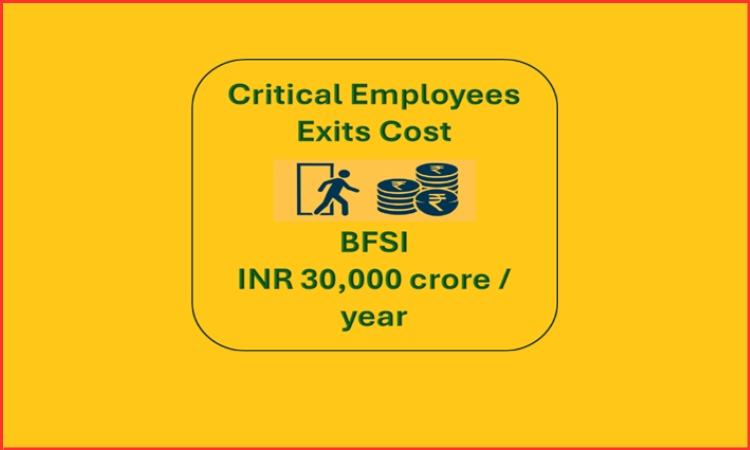
Then how does it amount to INR 30,000 crore per year?
To arrive at the estimated cost of employees’ attrition can be computed on the basis following assumptions:
| Total employees within BFSI domain | 90 lacs to 1 crore employees |
| Critical / senior roles (5%) | 5 lacs employees |
| BFSI attrition rate (15% -25%) However, assuming a conservative 10% attrition for critical roles | 50,000 exits per year |
| BFSI average salary (INR 20 lacs to 45 lacs) | Average CTC for critical roles– INR 30 lacs per annum |
| Revenue loss (1.5x to 3x) Let’s assume at 2x | Average cost per exit per annum – INR 60 lacs |
| Total operations loss (50,000 exits X INR 60 lacs) | INR 30,000 crore per annum |
This is an indicative estimation of the cost for key employees’ exit. Actuals may vary from one organization to another.
So, which roles are considered critical?
As highlighted above, around 5% roles are considered critical among the entire population of 1 crore employees in the BFSI sector. Which are these roles? Let’s look at these level-wise.
| CXOs | CEO, CRO, COO & Chief Compliance Officer |
| Functional Heads | Collections, Analytics, Tech platforms, Product, Operations, Credit |
| Other leads/ individual contributors | High performing professional in Sales, Credit, Ops, Collection, Product and Technology |
These roles are considered critical due to following reasons –
- Knowledge-centric roles. These individuals not only understand the internal way of doing things but also know the why behind them. They can take the organization out from a tough conversation be it with an investor, regulator or client.
- They are in the driving seat. They participate not only in strategy but also in execution. They have participated in every aspect of their function and shaped the way their function operates today.
- They are the brand ambassadors of the organization in the market.
- They are the first ones to raise the changes in the organization by keeping an eye on market shifts.
- With them moving out, it is more likely to follow a few more exits. Also, a few initiatives to be dropped considering the expertise gap.
Conclusion
Fresh talent in the organization is always welcome. However, each exit creates an impact. While some leave a significant dent.
There is no way to say that a new hire does not take the organization to the next level. However, here, the focus is more on interim losses cause of attrition. The critical aspect of these attritions is to focus more on following –
- Plan transition within Organization before employee chooses to leave. This will help to have replacement being ready before the actual exit.
- Creating knowledge bases so that important information is not lost in transitions.
- If your organization is losing more than average. It’s time to focus on cultural or policy issues.
Organizations do not come to an end when anyone leaves, but the marks are visible. Make these marks as light as possible.

Authored by
Swapnil Singh
SVP – Risk Management & Operations, CredAble
Views here are personal