Currently, advertising is key to business practices. Companies around the world spend huge amounts on ads yearly – think TV commercials, social media posts, sponsorships, and endorsements. This all adds up to billions for big corporations. For many firms, ad spending is just as vital for their success as coming up with new products.
Yet, several of the globe’s top-earning firms disagree. Rather than splashing cash on ads, they focus on making excellent products and relying on their good reputation and word-of-mouth buzz. Their stories show us that building trust can lead to major business success without a heavy ad budget.
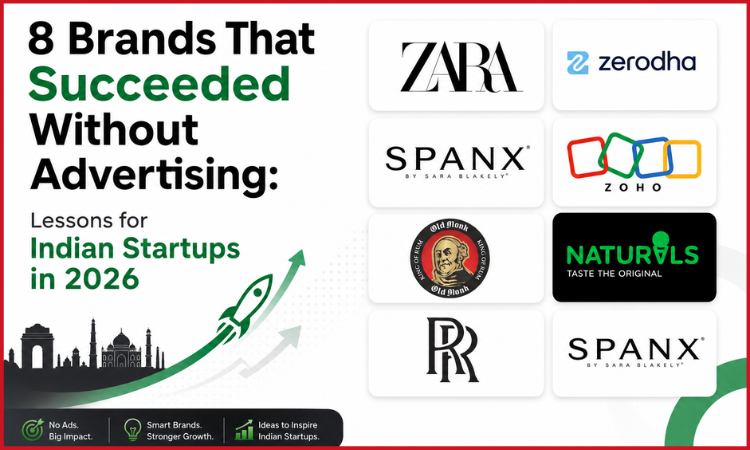
This essay dives into eight firms, seven from India and one set of multinational corporations, which all thrived with little to no money spent on ads. It highlights how well they’ve shown that this strategy can work internationally.
How Can Startups Grow Without Advertising in 2026?
Currently, the Indian startup industry faces a period of rapidly increasing marketing expenses. Online advertisement on Facebook, Google, and YouTube is becoming increasingly expensive, whereas TV ads and IPL are beyond the budget of many firms. At the same time, the customer preferences are changing, making trust more valuable than ever before. It means that those organizations who focus their attention on the quality of goods rather than marketing expenses benefit from the current situation.
Case Study 1: Zerodha — India’s Largest Brokerage Grew Without Ads
The Kamath brothers, Nithin and Nikhil, launched Zerodha in 2010. The company changed India’s brokerage market by offering low-cost trading and simplifying investment for regular customers.
Zerodha grew to become India’s largest stockbroker without using media advertisements, celebrity endorsements, or sponsored customer acquisition techniques over the last decade.
Key Metrics
| Metric | Value |
| Founded | 2010 |
| Active clients | 7.58 million+ active clients |
| Retail market share | Nearly 16% (2025) |
| FY25 revenue | ~₹8,847 crore |
| FY25 profit | ~₹4,237 crore |
| Profit margin | ~48% |
| Advertising spend on customer acquisition | Effectively ₹0 (minimal paid ads; growth driven by organic/earned channels) |
How Zerodha Grew Without Advertising
Zerodha revolutionized the broking industry by cutting down exorbitant charges that had existed. The zero-brokerage approach for equity financing quickly gained the attention of regular investors unhappy with traditional broking firms.
Rather than investing money in advertising, the company opted to invest in better products and educating customers about its services. Zerodha’s Varsity platform is among India’s most sought-after financial education programs. Millions of people got introduced to Zerodha through informative content.
Transparency was yet another vital factor behind the success of the company. Nithin Kamath frequently revealed the company’s secrets, its mistakes, and discussions regarding finances, inspiring confidence in a skeptical sector.
The final result was profitability. While other fintech firms were using the money for marketing purposes, Zerodha created one of the most profitable businesses in India, almost organically.
Case Study 2: Zoho — Global SaaS Growth Without Marketing Hype
Zoho started as a modest software startup in the 1990s and has now grown into one of the world’s largest bootstrapped SaaS companies. The company provides businesses with CRM, accounting, HR, analytics, collaboration, and enterprise software.
Unlike many worldwide SaaS companies, Zoho grew globally without relying primarily on advertising or venture capital funding.
Key Metrics
| Metric | Value |
| Founded | 1996 |
| Employees | 15,000+ |
| Global users | 100 million+ |
| Countries served | 150+ |
| External funding raised | $0 ( bootstrapped) |
| FY25 revenue | ₹12,313 crore |
How Zoho Grew Without Advertising
The company Zoho mainly focused on product development and customer retention. Zoho did not focus on acquiring users but slowly created its own ecosystem of commercial software.
The founder of the company Sridhar Vembu placed more importance on sustainability, profit, and quality rather than expansion.
Since Zoho was completely self-funded, the firm had no need to spend money on any growth-driven marketing programs. Users would naturally integrate more Zoho software within the existing ecosystem.
In summary, Zoho was able to successfully compete on the world stage against many bigger software firms due to its careful management style.
Case Study 3: Old Monk — How a Cult Rum Brand Built Loyalty Without Ads
Old Monk is one of India’s best recognized alcoholic beverage brands. Despite minimal traditional advertising, the rum gained a loyal consumer following across generations after its introduction in the 1950s.
Old Monk became more than just a beer brand. It became a cultural icon connected with college dormitories, military canteens, nostalgia, and affordability.
Key Metrics
| Metric | Value |
| Introduced | 1954 |
| Advertising spend | Virtually zero |
| Peak sales | 8+ million cases annually |
| Decades as India’s leading dark rum brand | Yes |
How Old Monk Grew Without Advertising
The difference between Old Monk and other alcoholic beverages was that it had built its brand image not on endorsements or sponsoring events but on the emotional loyalty of the product to the consumer. The beverage was affordable and consistent in quality for decades. Customers were sure about the taste, could instantly identify the brand by the packaging, and linked it to their experiences. Word of mouth was responsible for promoting the drink more than advertisements. Each generation has been passing on the drink to new generations, forming a sustainable loop of brand loyalty.
Case Study 4: Naturals Ice Cream — Quality as a Marketing Strategy Without Ads
Naturals Ice Cream was founded with a simple idea “create ice cream using real fruit and natural ingredients”.
At a time when many competitors relied heavily on artificial flavors and preservatives, Naturals focused on authenticity and freshness.
Key Metrics
| Metric | Value |
| Founded | 1984 |
| Starting capital | ₹3.5 lakh |
| Outlets | 170+ |
| Advertising spend | Less than 1% of revenue |
| Known for | Real fruit-based flavors |
How Naturals Grew Without Advertising
Naturals distinguishes itself via taste rather than promotion. Seasonal tastes such as sitaphal, mango, soft coconut, and lychee were client favorites since they tasted much different than mass-market counterparts.
The company prioritized ingredients and consistency over promotional tactics. Customers who had used the product automatically recommended it to friends and family.
Instead of just impulsive purchase counters, its stores evolved into destination retailers. Word-of-mouth generated significant recurrent demand, particularly in metropolitan areas.
Naturals demonstrated that true product differentiation can be a company’s most effective marketing tactic.
Case Study 5: Tally — Accounting Software Dominance Without Mainstream Ads
Tally became India’s best renowned accounting software brand because of dependability and professional confidence. The organization has established itself as the default accounting solution for millions of small and medium-sized businesses.
Despite leading its sector for decades, Tally has never relied extensively on showy advertising or influencer marketing.
Key Metrics
| Metric | Value |
| Businesses using Tally | 2.5 million+ |
| Presence | 100+ countries |
| Dominant player in Indian MSME accounting | Yes |
| Mainstream advertising | Minimal |
How Tally Grew Without Advertising
Tally expanded through professionals’ recommendations. Accountants trained on the software recommended it to others. Because of its ease of use, dependability, and compliance support, the software has been deeply embedded in India’s MSME ecosystem.
Training institutes and commerce students also helped the company flourish. As Tally became the standard tool for accounting education and professional employment, usage grew organically.
The organization demonstrated that good process integration can result in market dominance without aggressive promotion.
Case study 6: Zara — Fashion Giant With Almost No Advertising Spend
Zara is one of the world’s largest fashion brands and the flagship company of Inditex. Unlike most global fashion retailers, Zara spends a remarkably small percentage of revenue on advertising.
The company instead built its competitive advantage around speed, scarcity, and store visibility.
Key Metrics
| Metric | Value |
| Parent company revenue (FY24) | €35.9 billion |
| Zara ad spend | Roughly 0.3% of sales |
| Presence | 90+ countries |
| Global stores | 2,000+ |
How Zara Grew Without Traditional Advertising
Zara replaced advertising with operational excellence.
Its fast-fashion system allows designs to move from concept to stores within weeks. Because inventory changes rapidly, customers know products may disappear quickly if they do not purchase immediately.
This scarcity creates urgency and repeat visits.
The company also uses premium retail locations as a branding strategy. Zara stores are positioned in high-footfall urban areas, giving the brand constant visibility without relying heavily on television or digital ads.
The model helped Zara become one of the most profitable fashion retailers globally while maintaining extremely low advertising expenditure.
Case Study 7: Rolls-Royce — Luxury Growth Through Exclusivity, Not Ads
Rolls-Royce represents one of the highest levels of luxury in the automotive industry. The brand is associated with craftsmanship, exclusivity, and prestige rather than mass-market visibility.
Instead of targeting millions of consumers, Rolls-Royce focuses on a very small group of ultra-high-net-worth buyers.
Key Metrics
| Metric | Value |
| Founded | 1904 |
| FY23 vehicle sales | 6,032 cars |
| Average vehicle price | Often above $500,000 |
| Prestige rank | One of the world’s most prestigious luxury car brands |
How Rolls-Royce Grew Without Advertising
Rolls-Royce mainly focuses on exclusivity for their marketing. They don’t spend much on mass advertising because their target audience values rarity more. These buyers are drawn to the brand because of its heritage, reputation, and custom crafting experience. Every car is uniquely made, too, stressing high status. Plus, Rolls-Royce gets a ton of earned media coverage. Their new models land on the pages of luxury, automotive, and business publications easily, without huge ad pushes. So, they show that class and exclusivity can do better than traditional promo methods.
Case Study 8: Spanx — Billion-Dollar Brand Built on Word-of-Mouth Without Ads
Spanx was founded on the basis of an obvious idea for a product and its creator who was comfortable dealing directly with their consumers. The founder of the company, Sara Blakely, started it with only $5,000 worth of her personal savings. Without much money to spend on advertising, Spanx relied heavily on recommendations from consumers as well as salespeople.
Key Metrics
| Metric | Value |
| Started with | $5,000 |
| Estimated annual revenue | $400–500 million+ |
| Company valuation | ~$1.2 billion |
| Founder retained ownership | For years |
How Spanx Grew Without Advertising
The company found success by tackling a real problem for consumers. Folks loved how comfy and practical Spanx products were, which led to rapid spread through word-of-mouth. Sara Blakely would often visit stores to show off her products and build rapport with staff.
This move helped Spanx get lots of positive media coverage too. Celebs jumped on board to promote the items, not to mention the boost from Oprah Winfrey’s endorsement on TV. Such mentions were seen as more trustworthy than regular ads, and they greatly increasedSpanx’s visibility. In the end, Spanx showed that customer support paired with a great product can launch a billion-dollar business.
Common Patterns: How These Brands Scaled Without Advertising (Lessons for Indian business)
1. Quality of Products over Promotions
All of these firms put user-friendliness above all other marketing measures. In particular, Zerodha made investing easier, Naturals used quality ingredients, Tally was reliable, and Spanx met consumer requirements. All these products received positive mentions from consumers who believed that these goods were worthy of being purchased.
2. Building Relationships Based on Trust
All of the companies mentioned here have built trusting relations with their clients. For instance, Zerodha disclosed information about what they did. Accountants trusted Tally, and Old Monk had built their reputation after years of operating in the market. Consequently, all these companies minimized the need to conduct customer-attraction campaigns.
3. Utilization of Scarcity as Part of Marketing Activities
Some companies relied on the scarcity approach to eliminate promotions. Zara’s quick turnover of products encouraged customers to make their purchase decisions fast because otherwise, there would be no chance of acquiring such things anymore. Rolls-Royce attracted its VIP clients through custom-made automobiles.
4. Profitability and Sustainability over Growth
In most cases, companies considered sustainability and profitability more important than quick growth and promotions. Zoho never used external financing; Zerodha managed to be one of the most profitable start-ups in India; Naturals gradually increased their presence in the market thanks to loyal customers.
Conclusion
These eight companies prove that traditional advertising is not the only route to large-scale business success.
Whether it was Zerodha building trust through education, Zoho scaling globally through product depth, or Zara creating demand through scarcity, each company found a different way to stay relevant without relying heavily on traditional advertising. Brands like Old Monk and Naturals Ice Cream succeeded through emotional connection and product authenticity, while Rolls-Royce and Spanx proved that exclusivity and customer advocacy can become growth engines themselves.
Together, they demonstrate a simple but powerful business principle:
Great products, customer trust, and strong retention can outperform massive advertising budgets.
Frequently Asked Questions
Q1: What companies have grown substantially without using advertising?
Some companies that have grown substantially without using advertisement include Zerodha, Zoho, Old Monk, Naturals Ice Cream, Tally, Zara, Rolls-Royce, and Spanx.
Q2: What was the reason for growth for Zerodha without spending anything on marketing?
The firm focused on low commissions, finance knowledge, transparency, and excellent user experience rather than trying to reach more customers by means of advertising.
Q3: Why is there no use of advertisements by Zara?
This firm gives much consideration to fast stock movement, rareness, premium placement, and efficiency, thus having less need for advertising.
Q4: Why do its advertisements not need advertising?
The target audience of this company includes ultra-high-net-worth clients who value privacy, uniqueness, craftsmanship, and prestige more than visibility.
Q5: Is there any chance for startups to grow without advertising by 2026?
Certainly, because such startups as the ones offering unique services and goods have chances to grow through recommendations and loyalty.