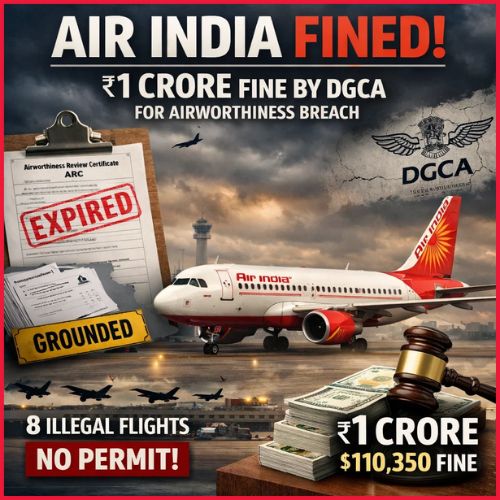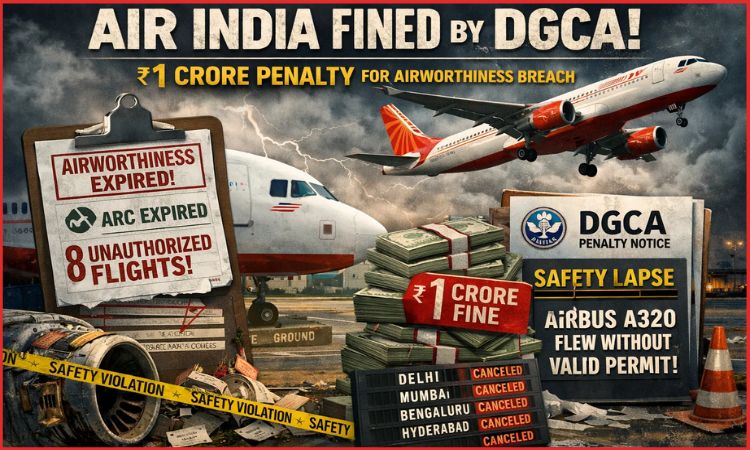
The skies over India are getting a bit more turbulent for the country’s second-largest carrier. In a move that has sent ripples through the aviation industry, the Directorate General of Civil Aviation (DGCA) has slapped a ₹1 crore ($110,350) fine on Air India.
The reason? A massive safety lapse in which an Airbus A320 took to the skies eight times without a valid airworthiness permit. For a brand currently under the global spotlight for its ambitious “Vihaan.AI” transformation, this regulatory hammer-blow raises a critical question: Is the airline’s rapid expansion outpacing its safety protocols?
The Anatomy of a Safety Lapse: Eight Flights, Zero Permits
According to a confidential order issued on February 05, 2026, the incident involved an Airbus A320 (formerly part of the Vistara fleet), which operated commercial flights on November 24 and 25. The aircraft ferried unsuspecting passengers between major hubs, Delhi, Mumbai, Bengaluru, and Hyderabad, despite its Airworthiness Review Certificate (ARC) having expired.
In the world of aviation, the ARC is the ultimate “green light.” It is an annual certification that proves a plane has passed all mandatory safety checks and is physically fit to fly. Operating without it isn’t just a clerical error; it’s a fundamental breach of aviation law.
Accountability at the Top: CEO Campbell Wilson in the Spotlight
What makes this fine particularly notable for the business community is where the DGCA pointed the finger. The regulator didn’t just blame a technical glitch; it held the “accountable manager” responsible. In this case, that means Air India CEO Campbell Wilson.
Joint Director General Maneesh Kumar stated that the lapse has “further eroded public confidence” and negatively impacted the airline’s safety compliance culture. For Business Outreach Magazine readers, this serves as a stark reminder of the “Accountability Gap” in corporate leadership, when systemic failures occur, the buck stops at the corner office.
Why This Matters for Investors and Passengers
- Systemic Failures: Air India’s internal probe acknowledged “systemic failures” and the need for a total overhaul of its compliance culture.
- Pilot SOPs: The investigation also found that pilots failed to follow standard operating procedures (SOPs) before takeoff, including missing expired certifications during their pre-flight checks.
- The Shadow of the Past: This fine comes as the industry is still reeling from the tragic Boeing Dreamliner crash in Ahmedabad in June 2025. With 260 lives lost in that disaster, the DGCA is no longer in the mood for leniency.
Air India’s Response: “Gaps Have Been Addressed”
In an official statement, an Air India spokesperson noted that the airline voluntarily reported the incident in late 2025. “All identified gaps have since been satisfactorily addressed and shared with the authority,” the airline claimed, reiterating its commitment to “operational integrity.”
However, for a Tata Group-owned entity, the reputational cost may far exceed the $110,350 monetary penalty. In a market where passenger trust is the most valuable currency, “regrettable” incidents like these are luxury items the airline can ill afford.
The Bottom Line for Aviation Business
The DGCA’s heavy-handed approach signals a new era of aviation safety in India. As Air India and Air India Express continue to merge operations and scale their fleets, the regulator is watching every flight path with a microscope.
For business leaders, the takeaway is clear: Growth without governance is a recipe for disaster. Whether you are running an airline or a tech startup, your “airworthiness” depends on the strength of your compliance, not just the speed of your engines.