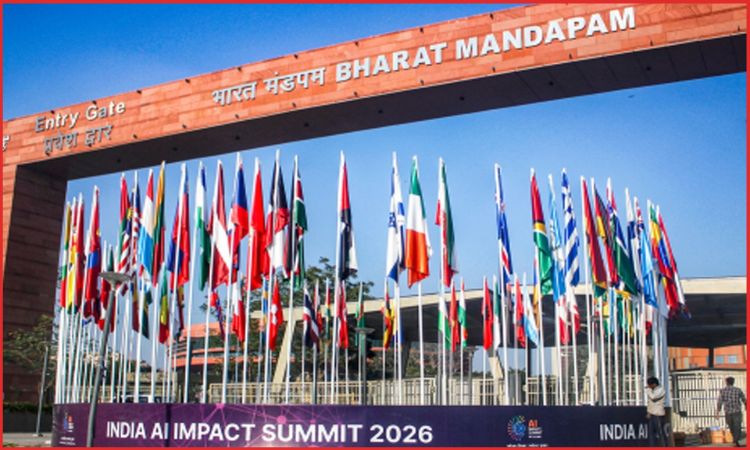
(Image Source: The Sunday Guardian )
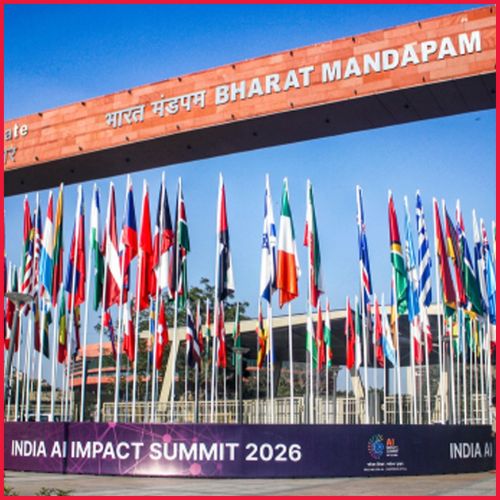
The world’s tech elite has a new destination, and it is not Silicon Valley. This week, all eyes are on New Delhi as India hosts the India AI Impact Summit 2026. Transforming the iconic Bharat Mandapam into a high-tech nerve centre, Prime Minister Narendra Modi is welcoming a “who’s who” of global leadership and tech royalty to chart the next decade of artificial intelligence.
For the business community, this is not just another conference; it’s the moment the Global South officially takes the driver’s seat in the AI revolution.
PM Modi and Global Tech Giants: A Power-Packed Guest List
The scale of the summit is unprecedented. From February 16 to 20, Bharat Mandapam will host over 20 Heads of State and 50 international ministers. However, the real buzz surrounds the CEO Roundtables.
Industry titans, including Sundar Pichai (Google), Sam Altman (OpenAI), Jensen Huang (NVIDIA), and Brad Smith (Microsoft), are descending on Delhi. They are not just here for the photo ops; they are here to negotiate the future of sovereign AI, data governance, and billion-dollar investment roadmaps.
Why This Summit is Different
While previous summits in the UK and France focused heavily on “AI Safety” and existential risks, India is shifting the narrative toward inclusive growth. Under the theme “Sarvajana Hitaya, Sarvajana Sukhaya” (Welfare for All, Happiness for All), the summit is prioritising:
- Democratizing Computing Power: Making AI accessible for startups and SMEs.
- AI for Social Good: Real-world applications in agriculture, healthcare, and education.
- The IndiaAI Mission: Showcasing indigenous LLMs (Large Language Models) tailored for diverse languages and datasets.
Key Highlights of the India AI Impact Summit 2026
Running parallel to the high-level policy talks is the AI Impact Expo, a massive showcase of innovation spanning 70,000 square meters.
- 300+ Exhibitors: Global giants and 600+ high-potential startups are demonstrating live AI solutions.
- 13 Country Pavilions: Nations like Japan, France, and the UK are showcasing collaborative tech ecosystems.
- The Three Sutras: All innovations are categorised under People, Planet, and Progress, emphasising sustainability alongside speed.
What This Means for Global Investors
For readers of Business Outreach Magazine, the takeaway is clear: India is positioning itself as the global laboratory for population-scale AI.
With over 35,000 registrations and an expected $100 billion in investment commitments on the horizon, the summit is a catalyst for new partnerships. Prime Minister Modi’s vision of “AI for All” is not just a slogan; it’s a massive market opportunity for companies specialising in digital public infrastructure (DPI) and ethical AI governance.
Final Thoughts
As the summit concludes later this week with the GPAI Council meeting, the “New Delhi Declaration on AI” is expected to set a new global benchmark. By focusing on “human-centric” progress rather than rigid regulation alone, India is carving out a middle path that balances rapid innovation with social responsibility.
Whether you are a tech founder or a policy enthusiast, the message from New Delhi is loud and clear: The future of AI will be written in the languages of the many, not just the code of the few.