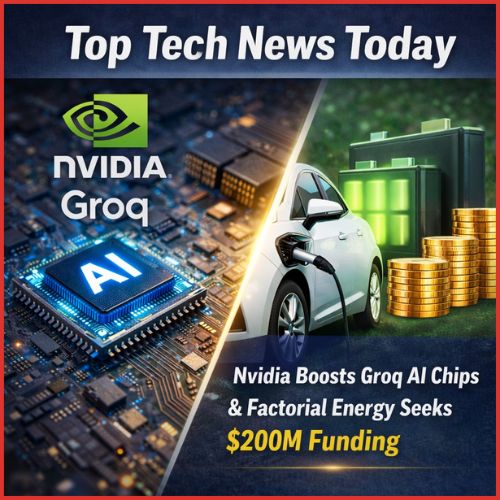
The tech landscape just shifted again, and if you are not paying attention to the “inference wars,” you are missing the biggest story in business today. While the world was busy watching stock tickers, two massive moves just signalled where the next decade of venture capital and industrial power is headed.
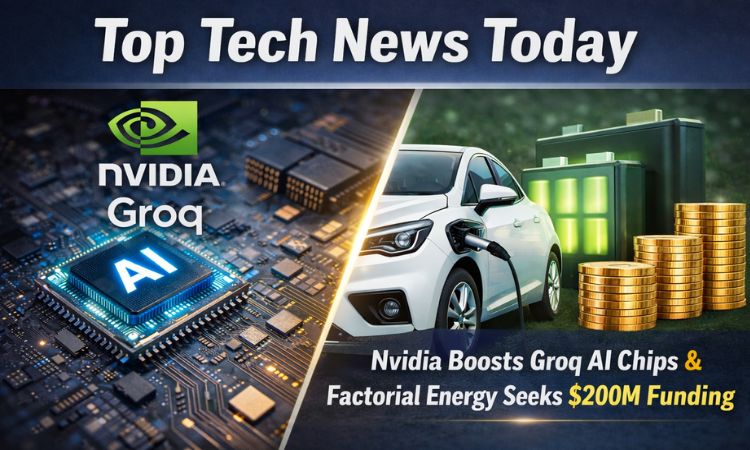
From Nvidia doubling down on specialised AI chips to Factorial Energy eyeing a massive $200 million funding round, the message is clear: the era of “one-size-fits-all” technology is over.
The Nvidia-Groq Alliance: Why Specialised AI Chips Are the New Gold
For years, Nvidia’s GPUs have been the undisputed kings of AI training. But as AI moves from the laboratory to the pocket of every consumer, the focus is shifting to AI inference, the actual “thinking” part of the process when you ask ChatGPT a question.
In a move that has sent shockwaves through the semiconductor industry, Nvidia is scaling production of Groq-designed AI chips. By partnering with Samsung’s foundry to ramp up output from 9,000 to 15,000 wafers, Nvidia is not just building hardware; it is securing a dominant position in the race for efficiency.
Why This Matters for Business Leaders:
- Energy Efficiency is the New Currency: Groq’s Language Processing Units (LPUs) are designed to be 10 times more energy-efficient than traditional GPUs. In a world of rising energy costs, this is a bottom-line game changer.
- Solving the Supply Chain Crisis: By diversifying away from ultra-scarce High Bandwidth Memory (HBM) and using on-chip SRAM, this partnership bypasses the bottlenecks that have stalled AI rollouts for months.
Factorial Energy: The $2 Billion Bet on Solid-State Batteries
While Nvidia dominates the digital world, Factorial Energy is quietly revolutionising the physical one. The Barcelona-based pioneer is reportedly exploring a $200 million funding round that would catapult its valuation to a staggering $2 billion.
Factorial is not just another battery startup. They are the frontrunners in solid-state battery technology, the “holy grail” of the EV industry. With backing from giants like Mercedes-Benz, Stellantis, and Hyundai, Factorial is proving that the future of mobility is safer, longer-lasting, and significantly more efficient.
The Impact on the EV Market:
Factorial’s technology promises up to 50% more range than current lithium-ion batteries. For businesses in logistics, fleet management, and automotive manufacturing, this is not just an upgrade; it’s the catalyst that will finally make mass EV adoption inevitable.
The Big Picture: What This Means for Your Outreach Strategy
For the readers of Business Outreach Magazine, these updates are not just tech trivia; they are market indicators.
- AI Integration: If you are a business leader, the news about Nvidia-Groq suggests that AI will soon become cheaper and faster to run. Now is the time to look at AI-driven automation and personalised customer experiences.
- Sustainability as Scalability: Factorial’s rise shows that investors are no longer looking for “green” ideas; they are looking for green infrastructure that outperforms legacy systems.
Conclusion:
The synergy between high-speed AI inference and high-efficiency energy storage is creating a new blueprint for the modern enterprise. Whether it’s Nvidia’s tactical production shift or Factorial’s unicorn-level funding, the goal is the same: speed, efficiency, and scale.
As we look toward the second half of 2026, the question for your business is not if you will adopt these technologies, but how fast you can pivot to stay relevant.