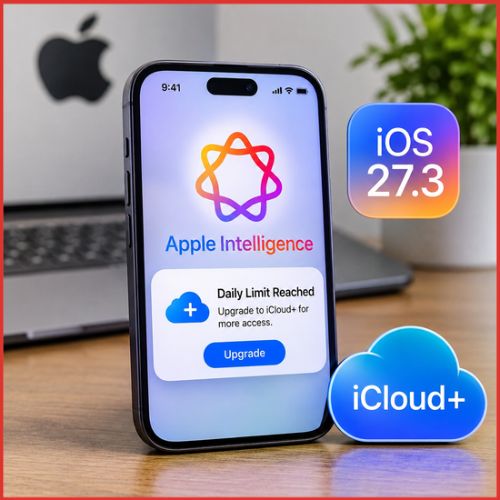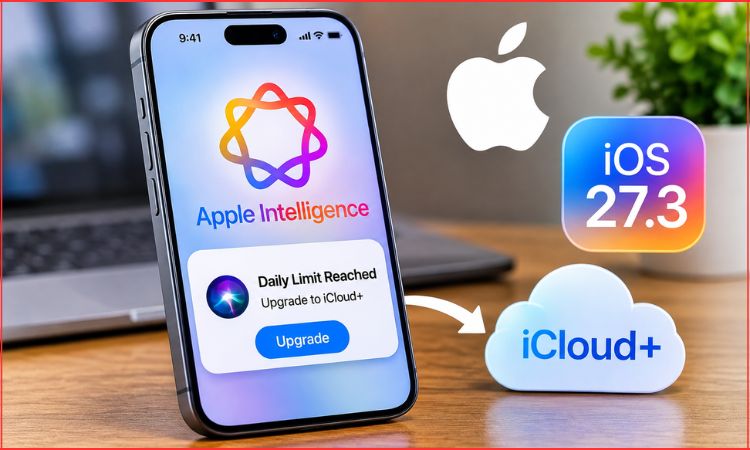
Apple is testing daily limits for some Siri AI and Apple Intelligence features, introducing a distinction between ordinary assistant commands and more demanding tasks that use cloud processing.
The changes reported in the iOS 27.3 beta would allow users to continue making basic Siri requests after reaching their allowance for advanced features. Additional access would be available through eligible iCloud+ subscriptions.
Apple’s support documentation confirms that certain server-dependent features are subject to daily limits. It also says allowances can vary according to the feature, request complexity, system demand and other factors.
The unresolved question is how those limits will feel during everyday use. Apple has not published a simple request count that tells users exactly how much advanced activity their daily allowance covers.
Basic Commands and Advanced Requests Follow Different Rules
The reported system separates routine commands from more involved requests.
Setting a timer is a straightforward action. Asking an assistant to find information, combine it with personal context and then complete another action involves a different workload.
That distinction becomes important when an assistant is expected to work across applications. A user may see one spoken instruction, while the system performs several operations behind it.
For the customer, the useful question is whether the assistant can explain clearly why one task remains available while another has reached a limit.
The beta coverage says basic Siri commands will continue working even after the advanced allowance is exhausted.
Several Apple Intelligence Features Are Included
The reported Apple Intelligence usage limits extend beyond conversational Siri requests.
They cover categories including advanced assistant tasks, image generation and editing, certain Shortcuts workflows and third-party applications using Apple’s cloud models.
These categories have separate allowances, according to the published coverage. Reaching a limit in one area would therefore not necessarily exhaust access to every other feature.
That structure could matter to people who use AI unevenly. Someone making extensive image edits may have little need for complex assistant requests. Another user may rely heavily on automated workflows while rarely generating an image.
Separate categories offer a way to distinguish those patterns, but they also require clear explanations within the interface.
A single warning that “AI usage is limited” would leave uncertainty about what remains available.
iCloud+ Becomes Part Of The AI Access Model
Beta reporting describes higher allowances through iCloud+ plans of 200GB and above.
The reported increases range from up to twice the allowance on the 200GB plan to up to 20 times on the 12TB plan. The 50GB subscription does not provide an increase.
Existing eligible subscribers would receive the additional access within their current plans, according to the coverage.
The phrase “up to” matters. It does not promise an identical number of requests for every feature or every task.
Nor does a multiplier reveal much without knowing the underlying allowance. Twice an unspecified limit remains difficult to translate into a daily workload.
For users considering iCloud+ AI access, practical experience may therefore be more informative than the multiplier alone.
The Beta Still Leaves Important Details Unclear
Published accounts differ on whether the free allowance is organised primarily by device or across an Apple Account.
Apple’s final documentation and the behaviour of the released software will need to establish the applicable rules.
The uncertainty is particularly relevant to people using several devices or sharing a subscription with family members.
They need to know whether activity on one device affects another, whether allowances are pooled and how the reset time is determined.
Those are operating details with a direct effect on value. A plan that comfortably supports one person’s use may feel different when several people draw on shared access.
Until the rules are clearer, precise claims about how many requests a household will receive would be premature.
Warnings Will Shape The Experience
The reports describe notifications when users approach or reach their limits.
A warning delivered only after a task fails leaves someone uncertain about whether the problem is capacity, connectivity or the request itself.
A useful message would identify the affected category and explain what the user can do next.
There is also a difference between interrupting an optional image experiment and stopping a workflow someone has come to depend on.
The more closely AI features become integrated into ordinary applications, the more clearly their availability needs to be communicated.
Users should be able to distinguish an exhausted allowance from a technical fault without having to investigate several settings.
Higher Allowances Do Not Establish Better Answers
A subscription-based increase concerns access, rather than accuracy.
More permitted activity does not guarantee that a generated answer, edited image or automated action is correct.
That distinction can become blurred when a paid tier is presented alongside more advanced functionality.
Customers still need to assess whether the feature performs the intended task reliably. The relevant measures include completion, correction effort and the time saved.
For someone using Siri occasionally, the free allowance may be sufficient. A heavier user may value additional access, but that judgement depends on actual use.
The Final Release Needs To Make The Rules Understandable
Apple’s testing points towards a model in which everyday commands remain broadly accessible while more demanding cloud activity has a daily allowance.
The commercial link to iCloud+ would give existing subscribers another benefit and offer heavier users a route to additional access.
The next step is clarity: consistent rules, understandable warnings and a practical explanation of what each plan provides.
The success of Siri AI limits will depend on whether people can use the assistant without unexpected interruptions.