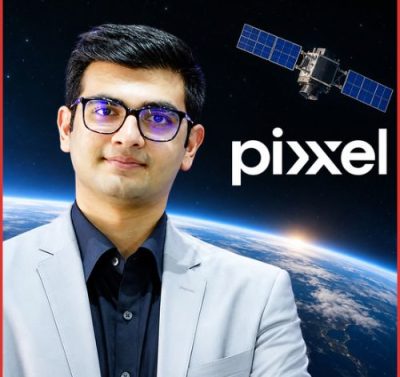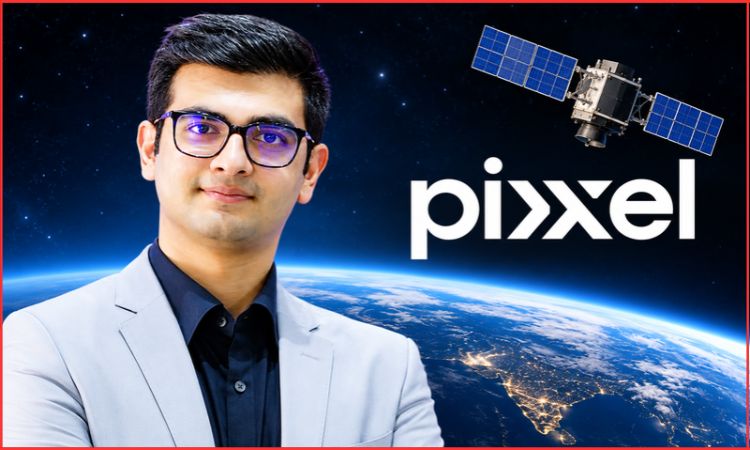
Most people picture rockets when they think about the space industry. Awais Ahmed looked at the data instead. The Pixxel success story begins with that choice, and it has turned a Bengaluru startup into one of the most talked-about names among Indian space startups.
Pixxel builds hyperspectral imaging satellites that read the Earth in far more detail than an ordinary camera in orbit can. Its founders, Awais Ahmed and Kshitij Khandelwal, started the company in 2019 with a simple aim: build a health monitor for the planet. In September 2026, Pixxel announced a $100 million Series C round, taking its total funding to $195 million.
This article walks through the Awais Ahmed biography, the thinking behind Pixxel space technology, the Pixxel business model, and what other founders can borrow from the journey.
Quick Glance
| Category | Details |
| Founder and CEO | Awais Ahmed |
| Company | Pixxel |
| Co-founder | Kshitij Khandelwal |
| Founded | 2019 |
| Headquarters | Bengaluru, India |
| Industry | Space technology, satellite imaging, Earth intelligence |
| Core technology | Hyperspectral imaging |
| Major product | Firefly satellite constellation |
| Data intelligence platform | Aurora by Pixxel |
| Total funding announced | $195 million as of September 2026 |
| Latest major funding round | $100 million Series C in September 2026 |
| Mission | Build a health monitor for the planet |
Who Is Awais Ahmed?
Awais Ahmed grew up in Aldur, a village in Karnataka’s Chikkamagaluru district. The internet was patchy back then, so books and encyclopedias did most of the teaching. He read about science, technology and the universe long before he had any real way to build something in that world.
That curiosity took him to BITS Pilani, where he studied for an integrated master’s degree in mathematics. Maths might seem an odd road into satellites, but the campus gave him something more useful than a syllabus. He worked on technical projects and spent time around working scientists.
One of those projects was a student satellite team that worked with scientists from ISRO. A satellite is not just an object that reaches orbit. Power, communication, sensors, heat and reliability all have to work together, and Ahmed got his first real look at that puzzle here.
Awais Ahmed Career: From Student Teams to Pixxel Founder
His second big lesson came from Hyperloop India, a student team that entered the SpaceX Hyperloop Pod Competition. Ahmed worked as an engineering lead and helped build a prototype pod. Nobody handed the students a manual for every step. They had to solve unfamiliar problems themselves, and the trip to SpaceX showed him how ambitious ideas get tested through quick experiments and plain engineering discipline.
After graduation, he skipped the usual job route. India’s private space sector was opening up, and he saw room for a young company to do work once tied to government agencies and big aerospace firms. Rockets demand huge capital, so he looked at satellite data instead. Plenty of industries need reliable information about the ground beneath them.
In February 2019, he co-founded Pixxel with Kshitij Khandelwal. As the Pixxel founder, Ahmed kept the direction clear from day one: don’t just launch satellites, help customers understand real-world problems.
Pixxel’s pitch makes more sense once you see how hyperspectral imaging works. A regular satellite camera records light in a handful of broad bands. Hyperspectral sensors split light into many narrow bands, so analysts can tell materials and conditions apart even when a normal photo shows nothing unusual.
Pixxel Space Technology and Hyperspectral Imaging Satellites
Picture two farm fields that look equally green. Hyperspectral data could show that one has stressed or dry crops. The same logic helps with mineral signatures, water quality and changes in ecosystems. Pixxel’s Firefly satellites capture more than 135 spectral bands at roughly five-metre resolution, and that mix supports plenty of uses:
- Agriculture: tracking crop health and spotting stress early
- Mining and energy: supporting mineral exploration and site monitoring
- Environment and water: watching vegetation, land conditions and water quality
- Climate research: adding data for studying land and ecosystems
One honest caveat: satellite data rarely gives a full diagnosis on its own. Teams still need ground observations and weather information to read it properly. That gap is where Pixxel space technology meets analytics, and it is exactly where the company sees its opportunity.
Milestones: Shakuntala, Anand and Firefly
Good technology means little until it survives launch. Pixxel’s first demonstration satellite, Shakuntala, went up on a SpaceX rocket on April 1, 2022. Anand, another demonstration satellite, followed later that year with ISRO. Both missions let the team test its hardware in orbit.
In February 2023, the company shared its first-light hyperspectral images, proof that the satellites could capture and send back useful observations. Customers want that kind of evidence before they depend on a supplier, so this was a quiet but important turning point.
The bigger leap came with Firefly. Pixxel launched its first three commercial-resolution hyperspectral satellites in January 2025, and three more joined them in August 2025, finishing the first phase of the constellation. A group of satellites can revisit the same places again and again, so users can follow change over time instead of studying single snapshots.
Pixxel Business Model and Aurora
A satellite company can sell images. Pixxel wants to sell answers. That shift sits at the heart of the Pixxel business model, and Aurora, its Earth observation intelligence platform, launched in August 2024 to make it work.
Aurora helps people who aren’t remote-sensing experts use hyperspectral data. A team watching a large farming region needs comparisons over time, location details and analysis it can act on, not just a picture. Software lets Pixxel meet that need.
The revenue mix looks like this:
- Satellite data sales to commercial and government buyers
- Software subscriptions for accessing and analysing data
- Government contracts for satellite capability and national projects
- Satellite manufacturing for commercial and strategic missions
- Specialised intelligence products for sectors like agriculture, energy and mining
Balance matters here. Building satellites eats cash upfront, so recurring software income and long-term contracts help carry the company. Commercial success also depends on reliable data, customer trust and proof that the insights deliver measurable value.
Funding and Investors Behind the Pixxel Success Story
Investors have backed Pixxel steadily. Early money came in 2020 with an $8 million seed round. A $27 million Series A followed in 2022, then a $36 million Series B in 2023 and a $24 million Series B extension in 2024. Backers have included Lightspeed, Blume Ventures, Radical Ventures, Seraphim Space and Google.
The biggest cheque arrived in September 2026: a $100 million Series C co-led by Temasek and Seraphim, lifting total announced funding to $195 million. Pixxel plans to use the money to expand its sensing capabilities, develop satellite systems, strengthen manufacturing and improve its Earth intelligence software.
The growing interest in Pixxel mirrors wider investor attention on India’s private space industry. These figures come from the company’s own announcements.
Indian Space Startups and Pixxel’s 2026 Moves
Pixxel now acts like a broader space infrastructure company. In January 2026, a consortium led by Pixxel signed an agreement with IN-SPACe to build India’s national Earth observation constellation. Dhruva Space, PierSight and SatSure are partners, and the plan covers 12 satellites with investment above ₹1,200 crore over five years.
In May 2026, Pixxel also announced it would develop India’s first orbital data centre demonstration satellite with Sarvam. It’s worth separating that plan from services that exist today, since it is still a demonstration project.
For Indian space startups, these moves show where the sector is heading. The next test is execution: delivering large projects, keeping customers happy, improving cash flow and holding up against international satellite operators and other emerging companies.
Conclusion
The Pixxel success story is really about patience and focus. A boy from a Karnataka village who loved books grew into the Pixxel founder, and with Kshitij Khandelwal he built a company around hyperspectral imaging satellites and Earth intelligence software.
A $100 million Series C and a role in India’s national Earth observation programme are big wins, yet lasting success will depend on turning ambitious projects into steady commercial results. Either way, Pixxel shows that Indian space startups can build real businesses, not just research projects, and that understanding our planet better can open the door to better decisions about the future.