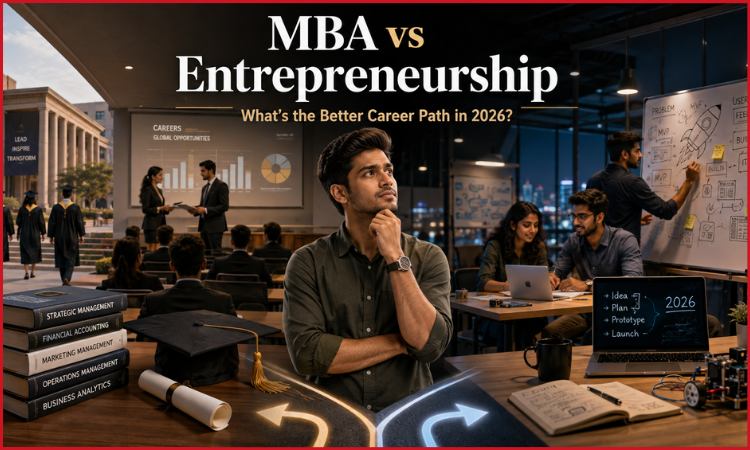
Naveen Tewari finished his MBA at Harvard Business School in 2007. He had elite placement offers waiting. Instead, he flew back to Bangalore, pooled savings with three friends, and ran a mobile ad network out of a cramped office with frequent power cuts.
That company became InMobi, India’s first unicorn. Tewari’s MBA gave him frameworks, capital access and a global network. It did not build the business; years of unpaid pivots, cold calls and near shutdowns did that.
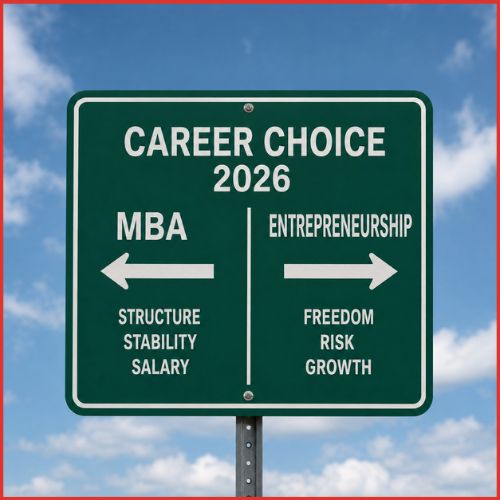
An MBA buys structure, a fixed two-year timeline, campus placements, a peer network, and a salary the day you graduate. Entrepreneurship buys none of that upfront. It offers equity, speed and the chance to build something that does not exist yet, with no guarantee it survives past year three.
This piece breaks down the numbers, the risks and the trade-offs behind the MBA or entrepreneurship decision in 2026, using placement data, government startup data and named examples rather than motivational noise.
Table: MBA vs Entrepreneurship – Quick Glance
| Attribute | MBA (Full-Time, India) | Entrepreneurship |
| Typical Start | Post-graduate, fixed 1-2 year duration | Any age, open-ended timeline |
| Known Names | Falguni Nayar (Nykaa), Matt Maloney (Grubhub, built during his MBA at Chicago Booth) | Falguni Nayar (Nykaa), Ritesh Agarwal (OYO) |
| Sector Reach | Consulting, finance, product, general management | Tech, D2C, fintech, services, deep tech |
| 2026 Key Metric | Median global starting offer of $120,000 (GMAC, 2026) | 1,97,692 DPIIT-recognised startups; 6,385 closed (PIB, 2025) |
| Current Standing | Employer hiring confidence for MBAs stayed above 90% through 2025 (GMAC) | India is the world’s third-largest startup ecosystem |
Background of the MBA Route
A full-time MBA is a structured, credential-based path. Two years of coursework, case studies, and campus placements convert into a title, a salary band, and a recruiter pipeline that already knows what to expect. In India, this runs through IIMs, ISB, XLRI, and private schools regularly covered in Business Outreach‘s education section.
The pitch is predictability. You know the fee upfront, and the curriculum doesn’t change based on how your first product launch goes.
Background of the Entrepreneurship Route
Entrepreneurship has no syllabus. It runs on product-market fit, cash runway, and a founder’s tolerance for ambiguity things no classroom fully simulates. Some founders build straight out of college; others, like Nayar, launch after a corporate career funds their risk appetite.
Government recognition under Startup India has made the path more structured, with tax breaks and formal registration now built in. The uncertainty hasn’t changed, though: most ventures still don’t survive to scale, a pattern Business Outreach’s startup desk tracks closely.
Cost and Time Investment
Table: Cost and Time Comparison
| Factor | MBA | Entrepreneurship |
| Upfront Cost | Rs 20-25 lakh at a top Indian B-school, often loan-funded | Near-zero bootstrapped to crore-scale seed rounds |
| Time to First Outcome | Fixed 12-24 months to a placement offer | Unpredictable months to years for footing |
| Opportunity Cost | 1-2 years of foregone salary, offset by the post-MBA jump | Foregone salary until the venture can pay the founder |
| Exit if It Doesn’t Work | Degree retains resale value regardless of first job outcome | Sunk capital and time; reputational cost varies |
The gap here is about certainty. An MBA converts a known cost into a mostly known outcome. Entrepreneurship converts an unknown cost into an unknown outcome why the startup vs corporate career decision is as much about temperament as money.
Earning Potential and Risk
Table: Earning Potential and Risk Profile
| Metric | MBA | Entrepreneurship |
| Typical Starting Compensation | Global median offer of $120,000 in 2026, down from $125,000 (GMAC) | No fixed floor; many founders draw below-market pay for years |
| Upside Ceiling | Bounded by corporate salary bands and equity grants | Uncapped on paper, tied to ownership and eventual exit |
| Failure Exposure | Career risk is mostly reputational if a first job underwhelms | About 3.2% of DPIIT-recognised startups had shut down by late 2025 (PIB); unrecognised early-stage ventures fail far more often |
| Funding Trend 2026 | Hiring plans steady but increasingly selective on AI fluency (GMAC) | India’s startups raised close to $11 billion in 2025, up nearly 17% (Tracxn) |
An MBA compresses years of business mistakes into two years of case studies. Entrepreneurship makes you live through the same mistakes in real time, with real money attached.
That line captures the difference bigger than any salary chart does.
Skill-Building, Network, and Career Flexibility
An MBA builds skills through simulation frameworks, group projects, and guest lectures from operators who’ve already made the mistakes ahead of you. The network is dense and front-loaded: one cohort can open doors across consulting, banking, and venture capital within weeks.
Entrepreneurship builds skills through consequence. A founder who mishandles cash flow doesn’t get a grade; they get a shortened runway. Business schools have noticed this gap. Forbes reports that Warby Parker, Rent the Runway, and DoorDash were all started inside business school programs, with entrepreneurship electives and incubators now standard at top MBAs.
An MBA holder can pivot into venture capital, corporate strategy, or startup leadership without starting over; Business Outreach’s finance and HR coverage both track. A founder who shuts down a venture carries real scars, but also a story many investors now read as an asset. MBA career opportunities and the harder-edged entrepreneurship career path increasingly look like two on-ramps to the same destinations, which is really what the business education vs entrepreneurship question comes down to.
Two lessons repeat across founder interviews. Time the decision to personal financial runway, not market hype. And treat an MBA’s real value as the peer network built during the program, not after it; Business Outreach’s roundup of tools for Indian entrepreneurs is a useful next stop past the decision stage.
The risks are concrete too. Founders who underestimate cash runway often shut down ventures with a viable product but no time left. MBA aspirants who take heavy loans without mapping them against realistic post-MBA salaries risk a payback period stretching past the two years often advertised.
Which One Comes Out Ahead
Neither path wins outright. The MBA route wins on predictability: a fixed timeline, known cost, and, per GMAC’s 2026 survey, sustained employer demand even as AI reshapes entry-level hiring. It also wins on downside protection; a mediocre first job rarely erases the credential’s long-term value.
Entrepreneurship wins on ceiling. No salary band caps what a founder can build, and India’s growing unicorn count, well documented in Business Outreach’s success stories archive, proves the upside is real. It loses on downside protection: the DPIIT closure figures confirm that risk isn’t evenly distributed.
Where a person lands depends on capital access, risk tolerance, and how much structure they need to perform. Founders re-entering entrepreneurship after an MBA often get both: business-school credibility plus the willingness to bet on themselves once resources catch up with ambition.
Key Takeaways
- MBA: fixed-cost, fixed-timeline path with a $120,000 global median starting offer in 2026 (GMAC)
- Entrepreneurship: no salary floor, uncapped upside tied to ownership and exit
- India had 1,97,692 DPIIT-recognised startups by October 2025, with 6,385 already shut down (PIB)
- MBA programs increasingly double as entrepreneurship launchpads, not just corporate pipelines (Forbes)
- Strongest founder profiles often combine business-school credibility with real-world risk tolerance
- Financial runway, not market timing, predicts which path a person can actually sustain
Conclusion
Neither an MBA nor a startup guarantees the entrepreneurial success 2026 founders are chasing; both simply load the dice differently. One trades ambiguity for structure and a known salary band; the other trades security for a shot at building something with no ceiling. Founders who combine business education with entrepreneurship, sequentially or through campus incubators, tend to hedge the weaknesses of each. For India’s founders and MBA aspirants weighing the MBA vs startup question this year, the honest answer isn’t which path is superior; it’s which risk profile they can live with for the next five years.
Frequently Asked Questions
1. Is an MBA still worth it in 2026 given rising AI adoption in hiring?
Employer confidence in MBA hiring stayed above 90% through GMAC’s 2025 and 2026 surveys, even as one in three recruiters report replacing some entry-level roles with AI. Value now leans more on communication and AI fluency than technical skills alone.
2. Does an MBA help or hurt someone planning to start a business?
It helps. Forbes points to Warby Parker and DoorDash, both built inside business school programs. Structured electives around venture creation give founders a head start bootstrapped entrepreneurs often lack.
3. What’s the real failure rate for startups in India?
Government data shows 6,385 of 1,97,692 DPIIT-recognised startups were closed as of October 2025, about 3.2% of the recognised base. Unrecognised early-stage ventures fail at considerably higher rates.
4. How do MBA salaries compare with what founders typically earn?
GMAC’s 2026 survey puts the global median MBA starting offer at $120,000, though Indian Tier-1 packages vary by school. Founders have no comparable floor and often draw modest pay for years.
5. Which path suits India’s current startup and job market better in 2026?
There’s no single right answer to MBA or entrepreneurship; it depends on risk tolerance and capital access. The MBA path suits those wanting predictable opportunities amid strong employer demand; entrepreneurship suits those prepared for the closure risk, DPIIT’s data confirms, in exchange for uncapped upside.
Read also: Top 10 Finance Business Ideas to Start in India in 2026