In recent years, India’s retail industry has undergone a remarkable transformation, with quick commerce emerging as one of its fastest-growing segments. Originally built around delivering groceries within 30 minutes, quick commerce has evolved into a multi-billion-dollar industry that now delivers everything from fresh vegetables and cosmetics to smartphones and home essentials within minutes.
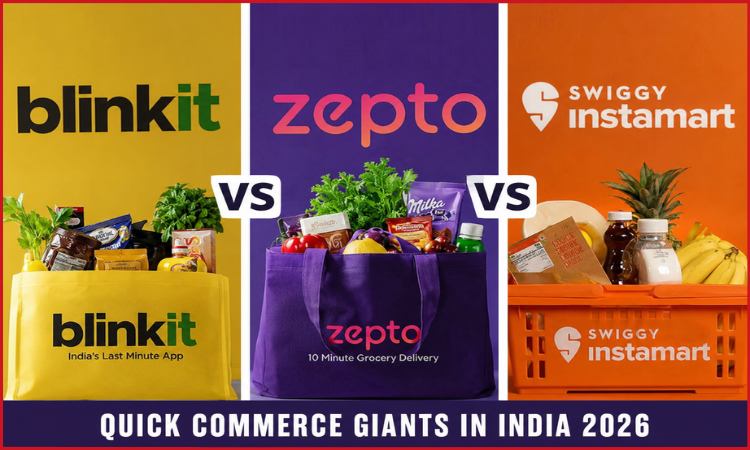
At the center of this revolution are three companies: Blinkit, Zepto, and Swiggy Instamart. These companies have redefined customer expectations, built thousands of dark stores across India, and sparked one of the country’s most competitive startup battles.
Global players such as Amazon and Flipkart are investing heavily in quick commerce while placing greater emphasis on profitability rather than growth alone. New hurdles keep appearing. Today, the competition is no longer just about the fastest delivery; it is about building the strongest and most sustainable long-term business.
India’s Quick Commerce Boom: Why the Market Is Growing So Fast
India’s quick commerce business is currently one of the fastest-growing retail markets worldwide. According to industry sources, the industry has grown manifold during the last year, fueled by urbanization, the rise in usage of smartphones, and lifestyle changes among consumers. Now millions of orders are placed daily, with forecasts pointing to high double-digit growth for the next few years.
Several factors are driving this momentum:
- Consumers are increasingly prioritizing convenience over traditional bulk shopping.
- Rapid urbanization has significantly increased the demand for instant delivery services.
- Dense networks of dark stores enable companies to deliver orders within 10–20 minutes in many urban locations.
- Product categories have emerged and grown from grocery into electronics, beauty, pet care, and household products.
- AI-powered inventory forecasting has improved product availability while enabling faster and more reliable deliveries.
Unlike traditional e-commerce, which focuses on larger but less frequent purchases, quick commerce thrives on high-frequency, everyday orders. This purchasing behavior helps drive recurring revenue and stronger customer retention.
Meet the Three Giants Dominating India’s Quick Commerce Market
A few players have emerged in this space, of which Blinkit, Zepto, and Swiggy Instamart dominate most of India’s quick-commerce.
Blinkit: The Market Leader
Founded in 2013 as Grofers, Blinkit completely reinvented its business after being acquired by Eternal (formerly Zomato), shifting its focus from online grocery delivery to quick commerce. This strategic transformation helped Blinkit establish itself as India’s largest quick-commerce platform.
Currently, Blinkit remains at the top with a widespread dark-store network, a recognized brand, and relentless category extension. Now users can place orders for anything ranging from their home needs, electronics, toys, office requirements, to lifestyle items, within minutes.
The analysts cite as another key advantage Blinkit’s improving unit economics and operational efficiency. Instead of lowering prices with discounts, they have increased order density, getting more orders per location, and completed profitable transactions, strengthening their leadership position in the face of competitors.
Zepto: The Fastest-Growing Challenger
Zepto is a startup founded in 2021 by young entrepreneurs Aadit Palicha and Kaivalya Vohra. It is currently one of India’s fastest-growing startups. Although there were many players before in the space with Blinkit, Zepto managed to make a name for itself in metros within a span of a few years by an aggressive growth drive.
The startup has raised hundreds of millions of dollars in funding and is preparing for one of India’s most anticipated IPOs. In its prospectus, Zepto showed that its revenue more than doubled in the last financial year, a sign of customers’ demand. On the other hand, fast growth has also amplified operating costs, bringing the company record losses as the business keeps pushing investments in dark stores, technology, and infrastructure.
Rather than competing only on delivery speed, Zepto has differentiated itself through customer experience, a premium product assortment, and a technology-driven supply chain.
Swiggy Instamart: Leveraging an Established Ecosystem
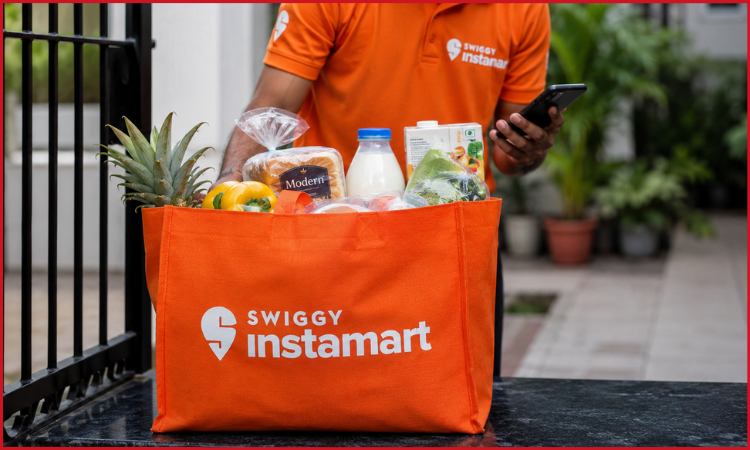
As opposed to Blinkit and Zepto, Swiggy Instamart has the advantage of an existing food-delivery ecosystem.
Existing Swiggy customers can order groceries and basic supplies on the very same application, thereby not only reducing customer acquisition costs but also inspiring them to use the same across platforms. An added benefit in this regard is the Swiggy One membership.
Despite trailing Blinkit in overall market share, Instamart continues to expand by leveraging Swiggy’s delivery network, technology, and logistics infrastructure.
Comparing Their Business Models
All three offer on-demand deliveries in a few minutes, but their business models vary widely.
Blinkit is very focused on scale and operational efficiency. Through its large network of dark stores, it has the ability to target more cities without compromising on fast delivery times and getting the best out of its inventory.
Zepto invests heavily in automation, demand forecasting, and technology-driven operations to strengthen delivery efficiency and rapidly expand its market share in urban areas.
Swiggy’s strategy focuses on ecosystem integration. Instamart integrates food delivery, grocery shopping and membership benefits into a single platform, providing new opportunities for customer engagement, while also capitalising on existing infrastructure.
These strategic differences explain why all three companies continue investing in different priorities while competing in the same fast-growing quick-commerce market.
The Market Share Battle
In the assessment of leadership, market share is still the benchmark.
While there is a slightly varying estimation across research firms, the general industry consensus remains the same. Based on industry estimates, Blinkit holds nearly 51% of India’s quick-commerce market, while Zepto and Swiggy Instamart continue to compete closely for second place.
Blinkit’s leadership is largely driven by years of investment in expanding its dark-store network, maintaining operational efficiency, and diversifying its product categories. At the same time, Zepto is rapidly closing the gap through aggressive expansion, while Instamart continues to strengthen its position by leveraging Swiggy’s broader ecosystem.
But the race is even broader than current rankings. Amazon Now and Flipkart Minutes are rapidly scaling up, opening hundreds of fulfilment centres and focusing on smaller cities where demand is expected to accelerate more quickly. A price war is breaking out between them and other existing competitors, squeezing margins but forcing firms to grow without losing money.
Revenue Growth vs. Profitability
Revenue growth alone does not provide the complete picture.
The biggest challenge in quick commerce is balancing ultra-fast deliveries with long-term profitability.
Blinkit has increasingly focused on improving profit margins through higher order density, better inventory management, and greater operational efficiency. The analysts equate this disciplined approach with a strong future path despite increased competition.
Meanwhile, Zepto continues to prioritize rapid growth. Its latest financial results show strong revenue growth, but they also reflect the significant investments required to expand its dark-store network, technology, and delivery infrastructure.
Dark Stores: The Backbone of Quick Commerce
Dark stores are the foundation of every successful quick commerce business. Unlike regular brick-and-mortar stores, dark stores are condensed fulfillment centers, dedicated exclusively to online orders. Located close to residential neighborhoods, these facilities enable delivery partners to fulfill orders within 10–20 minutes.
The effectiveness of a dark-store network depends on operational decisions such as store locations, inventory selection, and local demand forecasting.
AI-powered demand forecasting helps companies optimize inventory levels, improve product availability, and reduce excess stock.
Presently, Blinkit has one of the largest dark-store networks in India. Thus, it benefits not only from superior delivery coverage and density but can also efficiently stock its dark stores. While Zepto plans to grow rapidly to gain coverage in top cities, Swiggy Instamart will gradually ramp up by piggybacking on Swiggy’s logistics network. As competition intensifies, optimizing dark-store operations has become a key competitive advantage.
Technology Is Becoming the Biggest Competitive Advantage
Getting the items to the customer quickly is no longer a differentiator. Technology has become one of the biggest competitive advantages in India’s quick-commerce market.
All three companies are turning to artificial intelligence and machine learning to help with forecasting, route delivery trucks more efficiently, and personalize recommendations to customers. These engines take into account millions of data points, including weather, local events, shopping trends, and everyday demand, to get an accurate idea of what each consumer is likely to want.
Technology also helps companies:
- Forecast inventory demand more accurately.
- Reduce stock shortages.
- Streamline delivery routes.
- Shorten delivery times.
- Boost warehouse productivity.
- Customise offers and recommendations.
In the modern era of intensified automation investments by companies, beating competitors will rely equally on technology and speed of delivery.
Beyond Groceries: Expanding Into High-Value Categories
Quick commerce is no longer restricted to grocery items.
Today, customers also use quick-commerce platforms to order electronics, beauty products, personal care items, household essentials, stationery, pet supplies, and other everyday products for instant delivery.
Higher-value categories benefit profitability too, as they tend to have better margins compared to regular grocery items. In an attempt to tap this potential, Blinkit, Zepto and Instamart are adding categories to their mix in a bid to have consumers use their app for their non-essential grocery run, instead of shopping with them only once in a while. This category expansion is one of the main reasons investors are betting on the future of this sector.
Customer Experience: Where Each Platform Stands
The customer experience continues to be one of the most important determinants of retention in quick-commerce.
Because of its wide product portfolio, high coverage, and consistent service quality across all major cities, Blinkit (formerly Grofers) has gained substantial consumer trust.
Zepto has established itself on a sleek app experience, a high-quality product range, and a technology-enabled shopping experience that resonates with the youth living in Indian cities.
Swiggy Instamart is more efficient within the Swiggy ecosystem. Customers who already use Swiggy for food delivery can conveniently order groceries through the same app while benefiting from services such as the Swiggy One membership.
Although fast delivery helps attract first-time users, long-term success ultimately depends on product availability, reliable deliveries, competitive pricing, responsive customer support, and an easy-to-use shopping experience.
Advertising Is Emerging as a Major Revenue Driver
Advertising is becoming one of the most important revenue drivers for quick-commerce companies.
The most rapidly expanding revenue driver in the industry is retail media. Brands are paying more and more money to advertise in the form of sponsored products, homepage banners, and sponsored search results.
For FMCG brands, quick-commerce platforms provide a highly effective advertising channel because customers already have strong purchase intent when they open these apps. As a result, sponsored placements often deliver higher conversion rates than traditional digital advertising.
As advertising revenue continues to grow, it is expected to become an increasingly important contributor to the profitability of quick-commerce platforms.
Why Profitability Remains the Biggest Challenge
Balancing rapid growth with profitability has never been easy. Profitability remains the biggest challenge for India’s fast-growing quick-commerce industry.
Every order involves multiple costs, including inventory storage, warehousing, packaging, last-mile delivery, delivery partner incentives, technology, customer support, and marketing. At the same time, intense competition continues to push companies to offer discounts and promotional campaigns to retain customers.
The objective is to optimize unit economics-the profit from every single sale. Companies are improving unit economics by increasing average order values, enhancing logistics efficiency, reducing inventory wastage, and generating additional revenue through advertising and private-label brands.
As a result, the industry’s focus has gradually shifted toward sustainable, profitable growth rather than rapid expansion at any cost.
Amazon and Flipkart Are Raising the Stakes
While Blinkit, Zepto, and Instamart currently dominate the market, Amazon Now and Flipkart Minutes are expanding rapidly, leveraging their nationwide logistics networks, strong supplier relationships, and significant financial resources. The entry of these companies is expected to intensify competition, accelerate innovation, and increase pricing pressure across the industry.
But large established players still hold advantages. Years of experience running heavy dark-store networks, fine-tuning last-mile logistics, and much better knowledge of local consumer habits will make scaling up in the face of rising rivalry less daunting.
Who Is Winning India’s Quick Commerce Race in 2026?
Each platform has established its own unique competitive advantage.
Thanks to its massive dark-store network, extensive range of items, improving profitability, and high operational efficiency, Blinkit continues to be the overall market leader.
As one of the fastest-growing challengers, Zepto continues to strengthen its position through aggressive expansion, technology-driven operations, and long-term growth strategies, including its planned public listing.
Swiggy Instamart leverages its integrated ecosystem to strengthen customer loyalty while expanding its presence through Swiggy’s established logistics network.
India’s quick-commerce market is evolving into a highly competitive ecosystem rather than a winner-takes-all race. Based on current market share, operational scale, and profitability trends, Blinkit remains the market leader in 2026, while Zepto and Swiggy Instamart continue to narrow the gap through innovation and expansion. As Amazon and Flipkart increase their investments in quick commerce, the next phase of competition is likely to be shaped by profitability, technology, and execution rather than delivery speed alone.
FAQs
1. Which quick-commerce platform will dominate the market in India in 2026?
Based on industry estimates, Blinkit is seen as the market leader, followed by Zepto and Swiggy Instamart.
2. Is Zepto profitable in 2026?
While Zepto has achieved strong revenue growth, significant investments in expansion, technology, and dark stores continue to put pressure on its profit margins.
3. What gives Blinkit a competitive advantage?
Supported by its large dark-store network, efficiency, wide product range, and improving economics per unit, Blinkit’s leadership position has strengthened.
4. Why is Swiggy Instamart different from Blinkit and Zepto?
Instamart leverages Swiggy’s existing food-delivery ecosystem, enabling it to cross-sell services and reduce customer acquisition costs.
5. What is the future of quick commerce in India?
India’s quick-commerce market is expected to continue growing as companies expand into new product categories, invest in AI and automation, strengthen their logistics networks, and compete with emerging players such as Amazon Now and Flipkart Minutes.