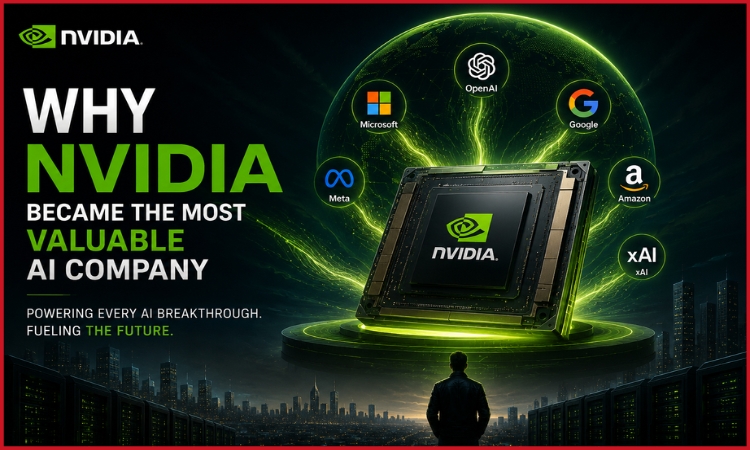
The AI boom created winners across software, cloud computing, enterprise technology, and new ventures. However, one company benefited from nearly every wave of investment, no matter which AI model, platform, or application prevailed.
The company was NVIDIA.
While many companies competed to capture value from artificial intelligence, NVIDIA positioned itself at the center of the entire ecosystem. Rather than vying in a specific AI category, it transformed into the foundational layer supporting every one of them. This strategic shift changed NVIDIA from a GPU producer into one of the most valuable firms globally.
Main Insight
- The majority of AI firms create value using AI technology.
- NVIDIA creates value from firms developing AI.
- That difference clarifies why NVIDIA emerged as one of the biggest beneficiaries of the AI revolution.
NVIDIA Didn’t Win the AI Race. It Built the Infrastructure Behind It.
The primary reason for NVIDIA’s dominance is its production of high-performance GPUs. Although it is accurate, that reasoning overlooks the bigger story. Powerful chips by themselves do not generate a trillion-dollar market value. Infrastructure reliance does.
Firms like OpenAI, Microsoft, Meta, Amazon, Google, xAI, along with thousands of startups, continue investing billions into AI infrastructure. Although these organizations fiercely compete with each other, many still depend on NVIDIA at some point in their AI infrastructure.
This creates a unique market position. Many technology firms rely on choosing the right winner. NVIDIA benefits from almost all of them.
In a gold rush, miners compete with each other, yet the company selling the tools profits no matter who finds gold. NVIDIA has successfully established itself as the tool provider of the AI economy.
The Actual Product Was Never the GPU
A major misunderstanding regarding NVIDIA is that its edge in competition derives solely from its hardware. The greater benefit is software.
In 2006, NVIDIA introduced CUDA, a software framework enabling developers to utilize GPUs for extensive computing tasks. Back then, AI had not yet reached mainstream usage, and many firms did not acknowledge its future importance.
Developers did.
Researchers, universities, AI laboratories, and machine learning engineers progressively structured their workflows around CUDA. In the following twenty years, NVIDIA gained something much more significant than hardware market share.
It accumulated ecosystem dependence.
Currently, AI infrastructure is intricately linked to CUDA libraries, optimization frameworks, deployment systems, research environments, and developer workflows. Replacing NVIDIA typically necessitates reconstructing large segments of the technical infrastructure instead of just switching hardware suppliers.
This is the reason why companies are increasingly assessing the expense of departing from the NVIDIA ecosystem instead of merely comparing chip performance.
NVIDIA Transformed AI Demand into Infrastructure Demand
The introduction of ChatGPT sparked a significant change in technology expenditures. Organizations no longer perceive AI as an experimental research project.
It turned into a priority for the boardroom.
Cloud providers, companies, governments, and startups rapidly started to invest heavily in AI infrastructure. This change fundamentally altered NVIDIA’s growth path.
The business transitioned from selling gaming equipment to providing the computational infrastructure needed to train and deploy large-scale AI systems. With the rapid increase in AI adoption, the need for NVIDIA’s infrastructure grew alongside it.
Recent financial results emphasize the magnitude of this change. NVIDIA announced fiscal 2026 revenue of around $215.9 billion, with data center operations emerging as the primary growth driver.
The change uncovers one of the most important insights in NVIDIA’s story:
NVIDIA’s success was driven by gaming.
Data centers made NVIDIA indispensable.
The Hyperscaler Spending Engine Accelerated Everything
The rise of NVIDIA cannot be understood without recognizing the influence of hyperscalers. Microsoft, Amazon, Google, and Meta have collectively committed hundreds of billions of dollars to the growth of AI infrastructure.
With these companies competing to develop bigger data centers and train more advanced AI models, the demand for computing surged. Each new AI model demanded increased processing power, bigger infrastructure investments, and enhanced GPU capacity.
This created a powerful flywheel. Greater AI adoption led to heightened infrastructure investments. Elevated infrastructure investment rose the demand for GPUs. Increased GPU demand led to wider CUDA usage. Increased CUDA usage enhanced NVIDIA’s ecosystem edge.
The outcome was not conventional product expansion.
It was ecosystem compounding.
The AI Tax: Reasons Every AI Firm Pays NVIDIA
A particularly intriguing method to grasp NVIDIA’s supremacy is via what numerous analysts casually refer to as the AI tax.
Every business joining the AI competition ultimately pays NVIDIA at some level in the hierarchy. OpenAI trains models through AI infrastructure. Cloud service providers increase AI capabilities. Businesses deploy AI workloads. Startups lease GPU resources from cloud services.
In numerous instances, NVIDIA benefits from all these activities.
The firm placed itself at the precise intersection where AI expansion translates into infrastructure investment. As AI companies compete for market dominance, NVIDIA benefits from the competition.
This is an exceptionally strong business model.
NVIDIA Developed One of the Most Powerful Lock-In Models in Modern Technology
Numerous conversations emphasize market share. The critical measure is the cost of switching.
Organizations utilizing AI workloads on NVIDIA infrastructure frequently construct complete operational processes centered around NVIDIA tools, libraries, deployment systems, and optimization frameworks. Eventually, these systems become thoroughly embedded in daily activities.
Changing suppliers is seldom an easy purchasing choice. It may include reconstructing software processes, retraining engineering groups, revalidating AI systems, transitioning infrastructure, and revising optimization components.
That degree of friction establishes a strong barrier that rivals find difficult to surpass. The outcome is a business model in which reliance on customers grows in value as time progresses.
NVIDIA Quietly Became an AI Infrastructure Firm
Numerous investors revised their view of NVIDIA as the company has stopped acting like a conventional chip maker. Its approach is increasingly focused on developing a complete AI stack.
Currently, NVIDIA is involved in GPUs, networking, AI factories, enterprise AI solutions, robotics systems, physical AI, deployment frameworks, and extensive infrastructure design.
During GTC 2026, Jensen Huang stressed the significance of AI factories, agentic systems, and physical AI. The message was clear: NVIDIA is broadening its focus beyond hardware and delving further into the AI value chain.
That positioning is significant because infrastructure firms generally achieve higher long-term valuations compared to component suppliers.
NVIDIA Controls the Scarcity Layer of AI
A seldom-mentioned factor contributing to NVIDIA’s financial success is scarcity.
With the rapid adoption of AI, access to advanced GPUs turned into a strategic benefit. In numerous instances, organizations prioritized competing for computing resources before vying for customers.
When supply consistently falls short of demand, pricing power rises. NVIDIA gained from this trend right when global AI spending surged.
Together with software lock-in and reliance on its ecosystem, scarcity contributed to enhancing margins and reinforcing NVIDIA’s leadership position, even amid increasing competition.
Jensen Huang’s Key Skill Was Timing
Many successful companies create strong products. Significantly fewer consistently position themselves ahead of platform shifts.
NVIDIA has successfully moved through multiple computing eras, such as gaming, parallel computing, deep learning, generative AI, agentic AI, physical AI, and AI factories. Instead of defending a single market, the firm consistently expanded into the next one.
This capability to anticipate major technology shifts enabled NVIDIA to stay ahead of demand rather than react to it. Gradually, that strategic timing evolved the company from a graphics hardware producer into one of the most influential infrastructure players in the AI economy.
Final Thoughts
The majority of firms in the AI boom are competing to build the next breakthrough. NVIDIA took a different approach by building the infrastructure powering those breakthroughs.
Through the integration of hardware leadership, software lock-in, and massive data center adoption, NVIDIA positioned itself at the center of the AI economy. With the growth of AI investment, the firm remains one of the biggest beneficiaries of that development.
NVIDIA wasn’t only involved in the AI revolution.
It became the foundation beneath it.
FAQs
What elements contributed to NVIDIA’s emergence as the top AI company in terms of value?
NVIDIA’s achievements extend beyond GPUs. The company created a robust ecosystem of software, AI frameworks, networking technologies, and data center infrastructure that numerous AI firms depend on to train and implement models at scale.
What is the significance of CUDA in maintaining NVIDIA’s supremacy?
CUDA allows developers to enhance AI tasks for NVIDIA hardware. Gradually, it became thoroughly embedded in AI research, development, and business processes, leading to high switching expenses for competitors.
How did the AI surge contribute to NVIDIA’s growth?
The swift uptake of generative AI has increased the demand for computing resources. As businesses, cloud service providers, and AI startups broadened their infrastructure, the need for NVIDIA’s GPUs and AI systems increased considerably.
What function do data centers serve in NVIDIA’s operations?
The main driver of NVIDIA’s growth has turned into data centers. They provide the essential computing infrastructure for AI training, inference, and large-scale implementations, positioning them as a crucial contributor to the company’s income.
Is NVIDIA’s edge solely reliant on hardware?
No. While its hardware is a significant asset, NVIDIA’s enduring advantage arises from its integration of hardware, software, developer ecosystems, AI platforms, and infrastructure solutions that form a solid competitive barrier.