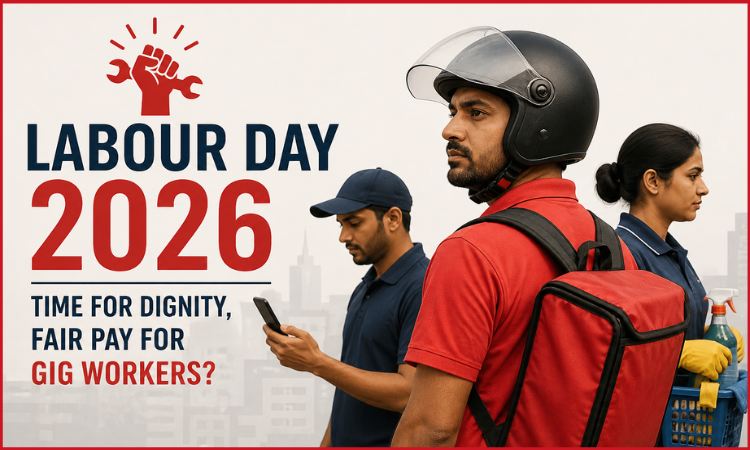
Every year on May 1, the world honours workers. Labour Day, born out of the 19th-century movement for an eight-hour workday, is a reminder that economic progress is for all. People doing the hard, unglamorous work in the shadows, keeps the rest of the wheels moving.
On any given day, lakhs of workers in India log on to apps, and get assigned to deliver someone’s dinner or groceries, or clean/repair a bathroom, or pick up a waiting rider — all at the algorithm’s mercy.
According to the Economic Survey 2025–26, tabled in Parliament in January this year, gig workers in India have grown from 7.7 million in FY2021 to 12 million in FY2025 — a 55% jump in just four years. According to NITI Aayog, that number is projected to reach 23.5 million by 2029–30, when gig workers will constitute 6.7% of India’s non-agricultural workforce and contribute an estimated ₹2.35 lakh crore to GDP.
Real people behind the 10-minute rush
The platforms driving this growth are now household names. Uber and Ola move people across cities. Swiggy and Zomato deliver food in minutes. Blinkit and Zepto bring groceries to the door in just 10 minutes. Urban Company sends a plumber or a salon professional — or even a housekeeper — to your home on demand. Porter handles last-mile logistics for businesses. Behind a smooth clickety-clack order on a smartphone is a human being absorbing the friction of the real world — traffic, weather, customer impatience and algorithmic pressure, all while fearing a negative review.
According to the ILO, India alone accounts for roughly 20% of the world’s platform workforce, making it the largest supplier of gig labour globally. Participation in the gig economy in emerging markets like India ranges between 5–12%, far higher than the 1–4% seen in developed economies.
The numbers on paper? Impressive.
The numbers in a gig worker’s pocket? Not so much.
The Economic Survey 2025–26 revealed that about 40% of gig workers in India earn below ₹15,000 per month. A 2024 study by the People’s Association in Grassroots Action and Movements found that 43% of delivery workers earn under ₹10,000 a month. According to a 2024 NITI Aayog report, 90% of gig workers lack savings and face high vulnerability to emergencies. A report by GiGWA and Janpahal found that over 30% of surveyed gig workers put in around 70 hours a week — well above the 40-hour standard enshrined in Indian labour law.
For most gig workers that work as ‘partners’, there is no paid leave. No provident fund. No health insurance is mandated by the employer. An account can be deactivated by an algorithm with no notice and no recourse.
Karnataka became the first state to attempt a fix — its Platform-Based Gig Workers (Social Security and Welfare) Act, 2025 mandates a 1–1.5% welfare fee on aggregators like Zomato and Uber to fund insurance and health benefits, and guarantees a 14-day notice before termination. It is a start, but every state needs to pitch in.
This Labour Day, as millions of Indians enjoy a holiday and order in, hail a cab, or book a home service with a simple tap, it is worth remembering who is at the other end of that transaction.
An Assocham-Primus Partners study says 64% of India’s gig workforce is between 24 and 38 years old. They are young, they are connected, and according to NITI Aayog, nearly 29% have only a middle school education — making the gig platform their primary route to economic participation.
They are powering a ₹2.35 lakh crore economy. They deserve more than the algorithm’s mercy.