On 15th July 2025, Group Captain Shubhanshu Shukla landed back safely on earth from his space journey to the International Space Station (ISS). He made history as the first Indian aboard the ISS — “humanity’s home in space”, as NASA calls it.
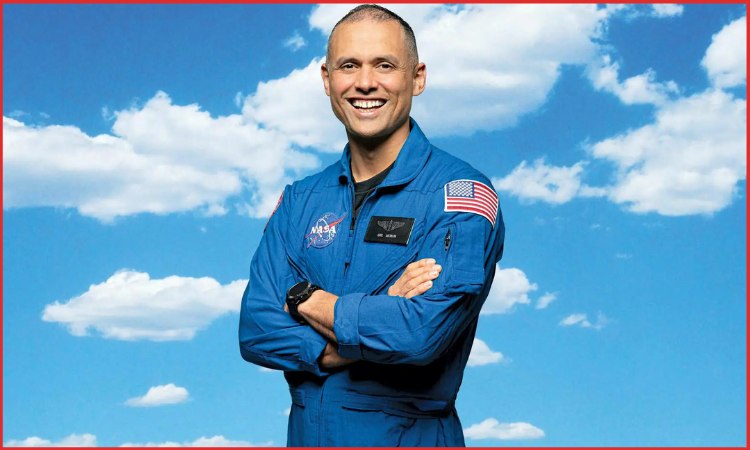
This July, another man with Indian blood in his veins will leave Earth, eyes and heart set upon the ISS. On 14 July 2026, NASA astronaut Dr. Anil Menon will launch aboard the Russian Soyuz MS-29 spacecraft from the Baikonur Cosmodrome in Kazakhstan. For India, a nation that has sent ISRO’s Chandrayaan to the Moon and is preparing its own Gaganyaan human spaceflight, this moment carries great pride.
Who is Anil Menon?
Anil Madhavan Samoilenko Menon was born on 15 October 1976 and raised in Minneapolis, Minnesota, to Ukrainian and Indian immigrant parents. The name Madhavan hints at roots that stretch back to Kerala.
His academic journey is nothing short of extraordinary. He earned a bachelor’s degree in neurobiology from Harvard University, a master’s in mechanical engineering and a medical degree from Stanford University. He is, in the truest sense, both an engineer and a doctor — the two professions every Indian parent quietly dreams of.
As a physician, he was a first responder during the 2010 earthquake in Haiti, the 2015 earthquake in Nepal, and the 2011 Reno Air Show accident. Nepal, of course, sits on India’s doorstep — and Menon was there in the rubble, saving lives.
His connection to India goes deeper than geography. After Harvard, he spent a year in India as a Rotary Ambassadorial Scholar to study and support polio vaccination.
Anil Menon’s SpaceX journey
Before becoming an astronaut himself, Menon spent years keeping others alive in space. He joined SpaceX in 2018, where he built its medical programme from scratch and served as lead flight surgeon for five launches, including the historic NASA-SpaceX Demo-2 — the first crewed flight of the Dragon spacecraft.  He was also the man responsible if something went wrong medically at the most critical moment in commercial spaceflight history.
Selected in 2021 as part of NASA’s elite 23rd astronaut class and graduating in 2024, Menon is an emergency medicine physician, mechanical engineer, aerospace medicine specialist, and a colonel in the United States Space Force.
What Menon will do at ISS
NASA astronaut Anil Menon is scheduled to stay aboard the International Space Station for an eight-month rotation as part of the Expeditions 74/75 mission.
After launching from Baikonur, Menon and his crewmates — Russian cosmonauts Pyotr Dubrov and Anna Kikina — will spend approximately eight months aboard the ISS, conducting scientific investigations and technology demonstrations to help prepare humans for future space missions.
These include research into human physiological responses during prolonged spaceflight and testing advanced life support systems. In simpler terms, he will help science understand what space does to the human body. This is knowledge that will be essential when India sends its own astronauts further and farther.
At a prelaunch news conference on April 29, Menon addressed the media and shared his plans. Regarding his excitement for the research, he stated: “Some of the things that I’m excited about are growing crystals for microchips that will speed up the way we can do things like AI. The space station is a testbed for that.”
He added, “I am super excited about anything related to health and medicine. There’s a bioprinter that’s printing cartilage that could be used for organs or things that people need as patients.”
On his advice for future astronauts: “Forgive yourself, take on challenges, take risks, and, if it gets a little uncomfortable, that might be a good sign that you’re working through something and you’re figuring it out.”
Why this matters to India and Indians
India is no longer just watching space happen. With Gaganyaan on the horizon and ISRO’s growing ambitions, the question of what humans endure in orbit is no longer abstract. Menon — Harvard-Stanford educated, with Indian roots, who once helped vaccinate children in India against polio — represents a bridge between two worlds.
When Soyuz MS-29 lifts off this July, a piece of India goes with it.