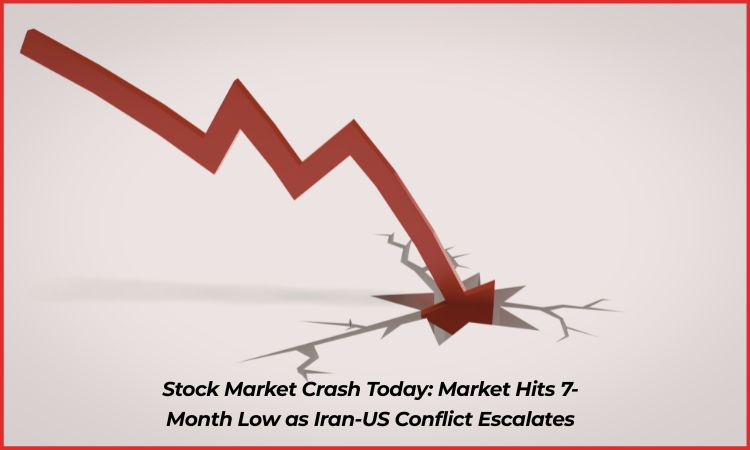
The opening bell on Dalal Street this Monday did not just signal the start of a trading week; it sounded an alarm. As the Indian stock market today witnessed one of its most turbulent sessions in recent history, the S&P BSE Sensex plunged over 2,200 points, while the Nifty 50 struggled to hold above 23,750.
But this is not just a routine correction. It is the ripples of a major geopolitical earthquake in the Middle East reaching Indian shores.
The Crude Reality: Why Brent is the Biggest Threat
The primary driver behind the Sensex crash today is the escalating conflict between the US, Israel, and Iran. Over the weekend, military strikes intensified, leading to a sharp spike in crude oil prices. With Brent crude surging toward the $ 115-per-barrel mark, India, which imports nearly 85% of its oil, feels the heat.
For a business audience, the math is simple but sobering:
- Current Account Deficit (CAD): Higher oil prices widen our trade gap.
- The Rupee Under Pressure: The Indian Rupee hit a record low, sliding past the 92.20 level against the US dollar.
- Inflationary Spikes: Rising fuel costs are a precursor to logistical inflation, potentially forcing the RBI to rethink interest rate cuts.
Sectoral Fallout: Winners and Losers in a War Economy
While the Nifty 50 live updates showed a sea of red, the impact was not uniform across the board.
The Hardest Hit: Auto and Banking
The PSU Bank and Auto sectors bore the brunt of the sell-off. As interest rate sensitivity increases and consumer sentiment wavers amid the threat of fuel price hikes, giants like Tata Motors and Mahindra & Mahindra have seen significant declines. Private lenders also faced pressure as Foreign Portfolio Investors (FPIs) offloaded shares worth over ₹6,000 crore in a single day.
The Resilience Factors: Defence and Energy
In every crisis, there is a strategic pivot. While the broader market bled, defence stocks like HAL and BEL remained resilient. Simultaneously, upstream oil companies like ONGC and Reliance Industries (RIL) found some support as higher global oil prices improved their realisation margins.
Investor Strategy: Panic or Patience?
Stock market crashes often trigger a “flight to safety,” with gold prices crossing the ₹80,000 mark. However, seasoned market veterans suggest a more disciplined approach.
- Avoid Leverage: In high-volatility environments (where the India VIX has surged 20%), leveraged positions can be wiped out in minutes.
- Look at Domestic Consumption: Sectors like FMCG and Pharma typically act as “defensive” plays during global geopolitical turmoil.
- The Long-Term View: Historically, geopolitical shocks have created short-term volatility but rarely derailed the long-term growth story of an emerging economy like India.
The Bottom Line
The current share market today is being dictated by headlines rather than balance sheets. Until there is a diplomatic breakthrough in the Middle East or a cooling of energy prices, volatility will remain the “new normal.”
For the modern business leader, the takeaway is clear: diversification is no longer just a strategy; it’s a survival mechanism.