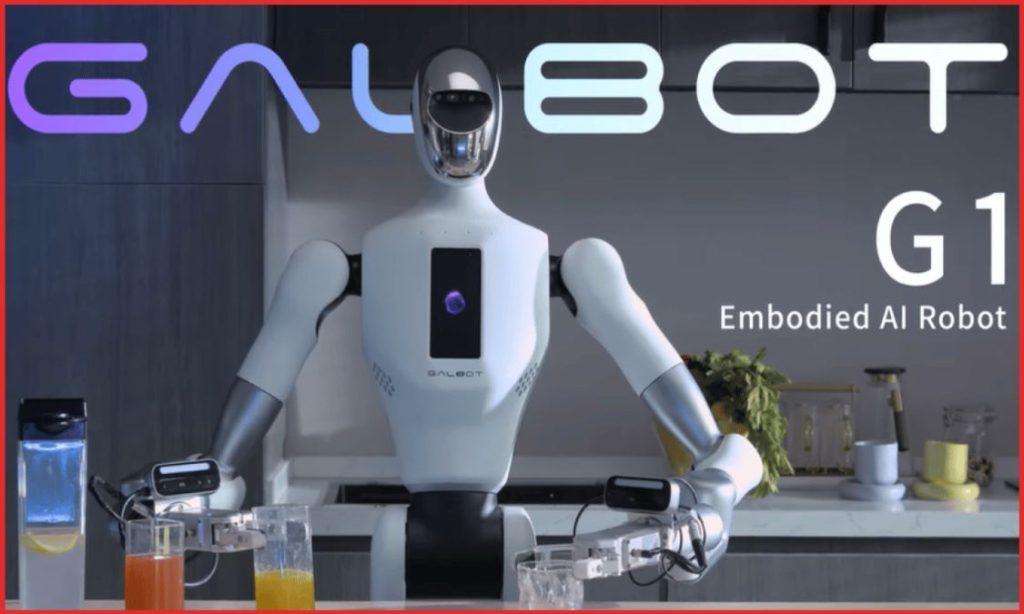
(Image Source: IoT World Today)
The robotics world is no longer just about concept videos and laboratory prototypes. It’s about capital, scale, and the ability to solve real-world labour shortages. Leading that charge is Galbot, the Beijing-based humanoid robotics powerhouse that has just sent shockwaves through the tech industry.
In a staggering display of investor confidence, Galbot has successfully raised 2.5 billion yuan (approx. $362 million) in its latest funding round. Even more impressive? This comes just three months after a previous $300 million haul, bringing their total capital raised in a single quarter to nearly 5 billion yuan ($700 million).
Why Investors are Betting Billions on Embodied AI
While many robotics firms focus on the “body,” the shiny metal and gears, Galbot is winning because they focus on the “brain.” This latest windfall, backed by heavyweight names like the National AI Industry Investment Fund, Sinopec, and SAIC Motor, is not just a financial milestone; it’s a stamp of approval for Embodied Intelligence.
Galbot is not building robots that just follow scripts; they are building robots that learn. By leveraging their proprietary AstraBrain, a multimodal large model, Galbot’s machines can navigate complex environments and handle delicate tasks without constant human reprogramming.
Key Highlights of the Funding Round:
- Total Raised: ~5 Billion Yuan ($700M) in 90 days.
- Current Valuation: Exceeding 20 billion yuan ($3 billion unicorn status).
- Lead Investors: National AI Fund, Sinopec, CITIC, and CATL.
- Core Focus: Mass production of the Galbot S1 and G1 humanoid models.
From the Lab to the Factory Floor: Real-World ROI
For readers of Business Outreach, the most compelling part of the Galbot story is not the funding; it’s the deployment. Unlike competitors who are still in “stealth mode,” Galbot’s robots are already working.
The company’s flagship Galbot S1 is a beast of industrial engineering. Designed specifically for heavy-duty manufacturing, it features a 50kg dual-arm payload capacity and autonomous battery-swapping technology. It doesn’t just work alongside humans; it replaces the gruelling, three-shift manual labour that traditional automation struggles to handle.
Beyond Manufacturing: The Retail Revolution
Galbot is also making a massive dent in the service sector. Their “Galaxy Capsule,” an autonomous convenience store model, has already scaled to over 100 locations across 20 cities. From 24/7 smart pharmacies to component sorting for global carmakers like Toyota and Mercedes-Benz, the use cases are expanding faster than the hardware can be built.
The “Post-90s” Visionary Leading the Charge
Behind this meteoric rise is Dr. Wang He, a Peking University professor and Stanford PhD. His philosophy is simple: Generalisation is the holy grail. “The real value lies in advancing intelligence rather than building cheaper shells,” Wang has noted in previous briefings. By prioritising high-quality synthetic datasets for training their AI, Galbot has managed to bypass the “data bottleneck” that slows other startups.
What’s Next for Galbot and the Robotics Industry?
With a war chest of nearly $700 million, Galbot’s next move is clear: global expansion and mass production. The company is currently eyeing a potential Hong Kong IPO as it prepares to move from hundreds of units to thousands.
As labour costs rise and the global working-age population shrinks, the demand for “embodied AI” is no longer a luxury; it’s a business necessity. Galbot is not just building robots; it is building the future workforce for the industrial and retail worlds.