In the early 1970s, when India’s middle class was forced to choose between quality and affordability, a government-employed chemist quietly launched a revolution. Karsanbhai Patel’s success story did not begin with venture capital, glossy branding, or corporate banking. Instead, he carried detergent packets door to door, challenging multinational giants that believed Indian consumers would take forever to pay a premium price for necessities.
But what follows is a fundamental shift in how Indian FMCG brands understood price sensitivity, mass consumption, and trust, driven by the rise of Nirma. Today, Nirma is more than a detergent brand; it is a symbol of indigenous entrepreneurship, frugal innovation, and inclusive growth.
This is the definitive Karsanbhai Patel success story, the man who democratised cleanliness and changed Indian FMCG forever.
Indian FMCG Landscape: Background
Before the 1970s, India’s FMCG market was dominated by a handful of multinational corporations. Detergents and soaps were priced beyond the reach of average households. Washing powder was considered a semi-luxury item, and branded alternatives were expensive.
Key Characteristics of the FMCG Market at the time
- Limited competition
- High dependence on imported raw materials
- Premium pricing strategies
- Low rural and semi-urban penetration
The Mind Behind the Brand: Karsanbhai Patel
Early Life and Education
- Born in 1945, Gujarat, India
- Education: BSc in Chemistry
- Early Career: Chemist at the New India Textile Industries Research Association (NITRA)
Karsanbhai Patel’s scientific background gave him an edge. While working at NITRA, he experimented with low-cost detergent formulations at home. He identified that effective detergents could be manufactured at a fraction of existing prices without compromising basic performance.
The Birth of Nirma: History & Case Study
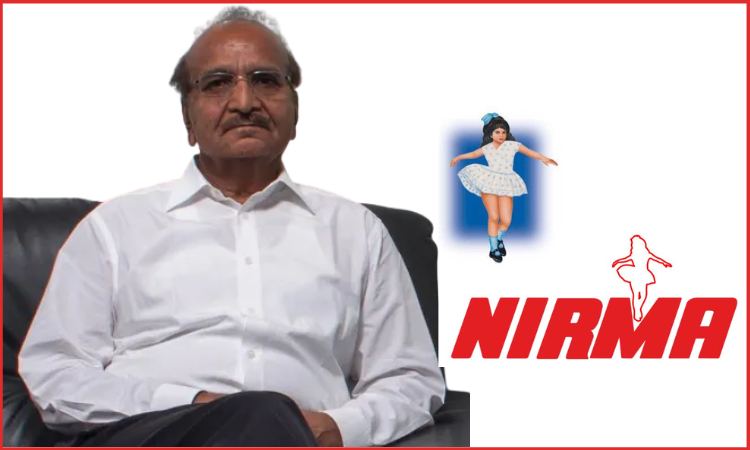
Karsanbhai Patel identified a significant market gap: many middle-class consumers could not afford high-priced detergents. He saw this as an opportunity, and this gave birth to a game-changing idea. In 1969, Patel started producing detergent powder from his backyard with a small loan of approximately ₹15,000.
He named it Nirma, after his lost daughter Nirupama. He also used her illustration (the girl in the white dress) on the packet and TV commercials to keep her memory alive.
Initial Strategy
- The selling price was ₹3 per kg, compared to ₹13–15 per kg charged by multinational brands.
- Distribution was door-to-door bicycle sales.
- The target audience was price-sensitive middle-class and rural households.
This was a radical move. Multinationals dismissed Nirma as a low-quality product. Consumers, however, thought differently and bought Nirma for their daily use.
How Nirma Changed the Indian FMCG Landscape?
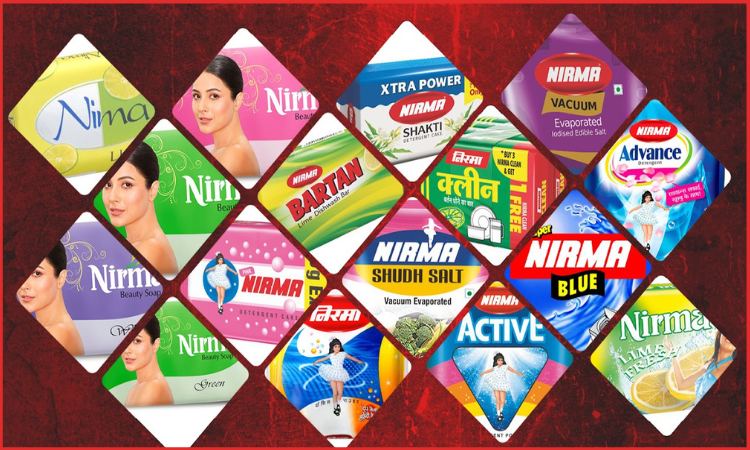
(Image Source: Nirma Limited)
Nirma’s success was built on value-based pricing, not cost-cutting at the expense of volume. Karsanbhai Patel optimised:
- Raw material sourcing
- Manufacturing scale
- Minimal advertising in the early years
This allowed Nirma to operate on thin margins while capturing massive volumes.
Marketing of Nirma
The iconic “Washing Powder Nirma” jingle became one of India’s most recognisable advertising campaigns, and its impacts were:
- Strong recall across income segments
- Cultural integration into Indian households
- High brand trust without aspirational overtones
Nirma proved that mass marketing did not need elite positioning. Instead, it required relatability.
Nirma vs Multinational Brands
By the early 1980s:
- Nirma controlled approximately 30% of India’s detergent market.
- Multinationals were forced to launch low-cost variants.
- FMCG pricing across categories began correcting downward.
Nirma triggered India’s first actual price war in FMCG, permanently reshaping competitive strategies.
Product Portfolio of Nirma
Over time, Nirma expanded into:
- Soaps
- Shampoos
- Toothpaste
- Salt
- Nirma Cement
This diversification reduced dependence on a single category and created a strong conglomerate structure.
Key Milestones in Karsanbhai Patel and Nirma’s Journey
| Year | Milestone | Impact on Indian FMCG |
| 1969 | Karsanbhai Patel formulates a low-cost detergent at home | Birth of indigenous, affordable FMCG innovation |
| 1972 | Launch of the Nirma Washing Powder at ₹3 per kg | Normalised the usage of detergent among middle-class households |
| Late 1970s | Door-to-door bicycle distribution model | Deep rural and semi-urban penetration |
| 1982 | An iconic “Washing Powder Nirma” ad campaign | Mass brand recall across India |
| Mid-1980s | Nirma captures approximately 30% of the detergent market share | Forced MNCs to produce lower-priced products |
| 1990s | Diversification into soaps, shampoos, toothpastes, and more | Reduced a single-category dependency |
| 2000s | Nirma’s entry into cement and chemicals | Transformation into a diversified conglomerate |
| 2014 | Acquired Lafarge India assets | Strengthened cement vertical presence |
| 2020 – Present | Focus on sustainability and operational efficiency | Long-term stability over aggressive expansion |
Awards and Achievements | Karsanbhai Patel Success
He was honoured with:
- Udyog Ratna Award in 1990
- Gujarat Businessman Award in 1998
- Ernst and Young Lifetime Achievement Award in 2006
- Sardar Vallabhbhai Patel Vishwa Pratibha Award in 2009
- Baroda Sun Lifetime Achievement Award in 2009
- Padma Shri Award in 2010
- Chemtech Award of Hall of Fame
- Doctorate of humanities for his philanthropy and business and marketing acumen in 2001, from Florida Atlantic University, USA.
- Doctor of Letters (DLitt) in 2007 from Devi Ahilya Vishwavidhyalaya in Indore
How Karsanbhai Patel’s Nirma Worked When Others Failed
Nirma became popular among consumers and worked out in the market, while others were identifying paths to success, because:
- India is not a low-income market. It is a value-conscious market.
- Distribution matters more than branding in mass categories.
- Affordability drives loyalty faster than aspiration.
Nirma’s success lies in understanding Indian consumption psychology, rather than copying Western FMCG models.
Challenges Faced by Karsanbhai Patel
Building Nirma was far from a smooth entrepreneurial journey. Unlike modern startups, he operated in an era with minimal institutional support and heavy regulatory control. Like other popular and successful brands, Nirma has also gone through several challenges, such as:
Quality Perception
Early criticism and accusations of Nirma being inferior created doubt among consumers. However, Karsanbhai Patel countered this through consistency rather than PR. As volumes surged, ensuring an equal quality across regions became critical. Major risks were:
- Batch inconsistency
- Supply chain disruptions
- Reputation damage
To meet these challenges, Patel invested in standardised manufacturing processes and internal quality audits that were uncommon for cost-focused brands at the time.
Regulatory Hurdles
During the 1970s and 1980s, India’s tightly controlled industrial framework restricted production capacity, expansion approvals, and access to raw materials, which impacted:
- Delays in manufacturing scale-up
- Government approvals slowed growth
- Limited flexibility in pricing and distribution
To cope with these, Karsanbhai Patel relied on gradual expansion and in-house chemical expertise to meet bureaucratic bottlenecks without compromising supply.
Competitive Pushback
As Nirma gained market share, global FMCG players struggled to match Nirma’s cost structure, proving that localised manufacturing and consumer insight outweighed global scale. Multinationals:
- Launched cheaper variants
- Increased advertising spend
- Attempted price undercutting
Environmental and Compliance Pressures
The use of chemicals and cements in manufacturing drew environmental scrutiny. The challenges are:
- Pollution control norms
- Waste management requirements
- Rising compliance costs
Nirma has increasingly aligned its operations with sustainability and regulatory standards to maintain long-term viability.
Karsanbhai Patel’s greatest challenge was not competition, but building growth without compromising affordability, ethics, or resilience. Each obstacle refined Nirma’s DNA, making it one of India’s most enduring business success stories.
Pros of Nirma in the Indian FMCG Landscape
- Inclusive consumption for millions of households
- Employment generation across manufacturing and logistics
- Indigenous industrial growth
- Reduced FMCG price inflation
- Strengthen domestic competition
Future Outlook of Nirma
Nirma is now focused on:
- Sustainable manufacturing
- Green cement production
- Modern retail penetration
- Legacy-led professional management
While not chasing hypergrowth, Nirma’s stability positions it as a long-term Indian conglomerate.
Conclusion
Karsanbhai Patel did not just build a brand; he built an economic movement. Nirma’s journey proves that meaningful innovation does not always come from technology or funding, but from empathy, discipline, and courage.
In an era obsessed with unicorn valuation, Nirma stands tall as a reminder that real success lies in impact, not headlines. For Indian entrepreneurs, Karsanbhai Patel’s success story is a blueprint for a thriving business.
FAQs
Q1. Who is Karsanbhai Patel, and why is he an important figure in Indian FMCG?
A: Karsanbhai Patel is the founder of Nirma Group and a pioneer of affordable FMCG in India. His innovation disrupted multinational dominance and made essential products accessible to millions.
Q2. How did Nirma compete with multinational FMCG brands?
A: Nirma competed through aggressive pricing, localised manufacturing, mass distribution, and culturally resonant advertising, forcing global players to adapt.
Q3. What is the current net worth of Karsanbhai Patel?
A: Karsanbhai Patel’s net worth is privately held and estimated to be between ₹4,000 and ₹5,000 crore, derived primarily from Nirma Group’s diversified businesses.
Q4. Is Nirma still relevant in today’s FMCG market?
A: Yes. While quieter than new-age brands, Nirma remains a strong player in detergents, soaps, and cement, with deep rural penetration.
Q5. What lessons can startups learn from Nirma’s success?
A: Nirma teaches founders the importance of pricing strategy, consumer insight, operational efficiency, and long-term vision over hype-driven growth.
Q6. Why is Nirma considered a case study in frugal innovation?
A: Nirma achieved growth without heavy capital, proving that innovation can thrive through simplicity, cost optimisation, and market empathy.