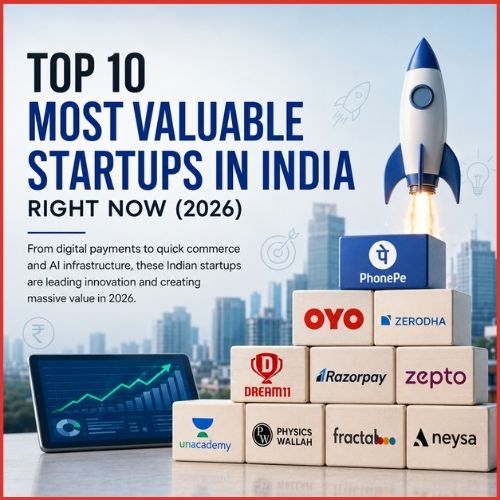
“If your dreams do not scare you, they are not big enough.” By Ellen Johnson Sirleaf. This quote perfectly captures the spirit of India’s startup ecosystem today. Now, it is no longer about ‘building for India,’ but about ‘building from India for the world.’
A silent revolution is taking place. Indian founders are thinking big, without limits, and the question ‘Can we go global?’ is no longer a doubt. Instead, ‘How fast can we grow and sustain on the global stage?’ is the whole point.
India’s startup ecosystem attracts investors through rapid innovation, a massive consumer base, and supportive policies. In the first half of 2025 alone, Indian startups raised approximately $5-6 billion in venture capital, keeping India among the world’s top three startup ecosystems by funding activity. (Source: AngelOne)
While ambition and innovation are the key foundations of entrepreneurship, strategic execution and access to capital ultimately drive scale. This article examines why Indian startups have become increasingly attractive to investors and what distinguishes them.
Understanding India’s Startup Landscape
India’s startup ecosystem has witnessed exponential growth over the past few years. As of 2024-25, India is home to over 1.25 lakh DPIIT-recognised startups, ranking 3rd globally after the United States and China (source: DPIIT, Ministry of Commerce & Industry).
These vibrant startups operate across high-growth sectors such as fintech, health tech, edtech, e-commerce, and more, supported by digitalisation and rising consumer demand. This rapid expansion of technology and digital services has catalysed the growth and created significant opportunities for entrepreneurs and investors alike.
Indian Startups Attracting Global Investors: Key Factors
Several structural and strategic advantages make Indian startups especially attractive to international investors.
- Large and Expanding Market
India’s population exceeds 1.4 billion, providing a massive consumer base for startups. The growing middle class is expected to reach 500-600 million by the late 2020s, driving sustained demand for innovative, affordable, and scalable solutions, an ideal environment for venture-backed growth.
- Accelerated Digital Transformation
The shift in India towards digital transformation has been a real game-changer. Rising internet penetration and widespread smartphone adoption have created a tech-savvy population. Indian startups leveraging technology and digital platforms to solve local challenges are well-positioned to capture market share and scale rapidly.
- Strong Government Support
The Indian government has launched several initiatives to support Indian startups. Programs like ‘Startup India’ and ‘Digital India’ aim to simplify the rules and regulations, provide funding support, and encourage innovative ideas. These initiatives simplify entry and accelerate startup growth.
- Diverse Funding Sources
India now benefits from a mature funding landscape that includes venture capital, private equity, angel investors, and sovereign funds. The global investment firms are increasingly setting up funds that target Indian startups specifically. The presence of both international and domestic investors increases the funding landscape and provides startups with access to massive resources.
- Robust Talent Pool
India has a strong educational system that produces a skilled workforce that excels in technology, engineering, and business management. This availability of talent at competitive costs is an attractive factor for startups, which allows them to innovate and grow efficiently. Investors are eager for companies that can tap into this talent to power the growth.
- Innovative Solutions
Indian startups are known for creating innovative solutions that meet local needs, from affordable healthcare technology to fintech solutions for underserved populations. These startups address every unique challenge faced by Indian consumers. These innovative ideas are why foreign investors are seeking impactful ventures in India that drive social change while delivering financial returns.
- Growing Focus on Sustainability
As the focus shifts toward sustainability, Indian startups are increasingly focusing on eco-friendly solutions. Companies that address environmental challenges attract investors interested in sustainable business practices. The emphasis on sustainability aligns with global investment trends and enhances the attractiveness of Indian startups.
- Global Mindset and Connectivity
Indian startups are not limited to serving only the local market; they are also looking to expand internationally. With international expansions, cross-border partnerships, and globally competitive products, Indian startups offer investors exposure to worldwide growth, not just local scale.
Sectors Attracting Global Investors
- Fintech: India’s fintech sector is leading the world in innovation, driven by digital payments, lending, and financial inclusion. With government initiatives such as the Unified Payments Interface (UPI) and Aadhaar-enabled payments, foreign investors are pouring capital into this fast-growing industry. Some of the significant deals include Paytm raising funds from SoftBank, Google Ventures, and Alibaba.
- E-Commerce: With e-commerce projected to reach $200 billion by 2026, global players are betting big on Indian startups in this sector. For example, Flipkart have secured multi-billion-dollar investments from Walmart, while Amazon has made substantial investments to compete in India’s expanding market.
- Healthtech: The pandemic increased investment in the sector, with startups attracting significant foreign investors. The government’s focus on digital health through the National Digital Health Mission has further catalysed this sector.
- Edtech: With millions of students transitioning to online learning, edtech startups such as BYJU’S and Unacademy have attracted significant investments from foreign venture capital firms. The National Education Policy 2020 (NEP 2020) also emphasises the role of digital education, creating even more opportunities for foreign investors.
Key Government Reforms for Foreign Investors
Source: Edukemy
Several government reforms have played a crucial role in securing funding for Indian startups and fostering a more transparent, streamlined, and investor-friendly environment. These reforms include:
- Relaxed FDI Norms
The Indian government has permitted 100% FDI in sectors such as e-commerce, fintech, and digital services. This has opened the gates for international capital, especially in emerging sectors such as fintech, edtech, and healthtech.
- Startup India Initiative
It was launched in 2016. The Startup India Initiative offers tax benefits, simplified compliance requirements, and government support for startups, making the Indian market more accessible to both local and foreign investors.
- Single-Window Clearance
This reform is to simplify the investment process. The government introduced the single-window clearance system to enable foreign investors to navigate India’s regulatory framework more efficiently.
- Production Linked Incentive (PLI) Scheme
This scheme is designed to boost domestic manufacturing. This scheme has attracted significant interest from foreign investors looking to capitalise on India’s growing role as a global manufacturing hub.
Fundings and Stats
| Year | Funding Amount |
| H1 2025 | Approx. $5-6 billion |
| Q1 2025 | $3.7 billion |
(Source: Tracxn, PitchBook)
Beyond headline funding numbers, sector-level trends reveal where investors are selectively deploying capital.
Sectoral Insights
The following are several Indian unicorns that reached multi-billion-dollar valuations during the 2021-22 funding cycle.
| Sector | Insight | Source |
| Fintech | UPI-led scale, but RBI norms are tighter | RBI, World Bank |
| SaaS | Strong global revenues from India | Bessemer |
| Healthtech | Digital health stack growth | NITI Aayog |
| Edtech | Funding correction, focuses on sustainability | Tracxn |
| E-commerce | Slower growth, but focus on margins | Bain, RedSeer |
Challenges
Despite its strengths, the Indian startup ecosystem faces challenges and addressing these issues remains critical for sustained global success.
- India’s regulatory environment can be complex. While the government is taking steps to simplify processes, compliance with local laws and regulations remains a challenge.
- The Indian startup landscape is highly competitive, with many players competing for market share.
- Understanding the local culture and consumers’ behaviour is essential for success in the Indian market.
- Despite advancements, India is still facing some challenges, including transportation, logistics, infrastructure, and supply chain inefficiencies. Indian startups operating in sectors that depend on robust infrastructure can face hurdles that could impact growth.
How Indian Startups Can Thrive on the Global Stage
- Think Strategically
Building a globally competitive business is not only about opening a new office or securing international media attention, but also about developing a solid growth strategy and management that align with business goals, customer behaviours, regulatory landscapes, and competitive insights.
- Build Connections
When it comes to global success, networking is as important as the business. Connect with international investors, mentors, accelerators, and market-entry partners to thrive on the global stage. These connections are not just for funding, but are about feedback, collaboration, partnerships, and market access.
- Win with Localised Playbooks
Another key reason Indian startups attract investors is that they benefit from a complex, diverse culture, varied income groups, and infrastructure gaps. But scaling a business globally demands a fresh perspective on market strategies; for instance, what works in India might not work abroad. That’s why doing in-depth research is essential to stand out globally.
- Experience Markets First-Hand
One of the most important factors is to absorb real-time market dynamics, form cross-border collaborations, and understand investors’ expectations from a global point of view. Through this immersion learning, the impact will be immediate and lasting.
Conclusion
Indian startups are a complete pack of ambition, talent, and resilience to lead on a global stage. But ambition alone is not enough, global connections are also meaningful. Despite many challenges, Indian startups and founders have been offering game-changing solutions. For investors seeking long-term growth, India is no longer an emerging opportunity, but a strategic imperative.
FAQs about Indian Startups Attracting Global Investors
Q1. How do the government policies support Indian Startups?
A: The Government initiates some policies, like ‘Startup India’ and ‘Make in India’, to provide multiple benefits to Indian startups, including tax exemptions, easier compliance, and faster registration processes.
Q2. What are the prime challenges faced by startups in India?
A: Some of the challenges faced by Indian startups are the regulatory issues, talent acquisition, and existing market competition. These challenges can hinder their growth, but they can be overcome with the right strategies and support.
Q3. How important is technology for the growth of Indian startups?
A: Technological advancements are critical for the growth of startups, such as easy access to high-speed internet, widespread smartphone adoption, and the use of technologies such as artificial intelligence, which have helped tech startups to grow in India.