
Source: makemoneyblog
Artificial Intelligence (AI) is no longer just a buzzword in India’s startup ecosystem. While hundreds of startups claim to be “AI-first,” only a small group of companies have successfully converted AI into sustainable, revenue-generating businesses. Most others remain stuck at pilot projects, demos, or valuation-driven narratives.
This article focuses on Indian AI companies that generate consistent business revenue through real customer adoption, long-term contracts, and measurable return on investment (ROI). Instead of hype, these businesses demonstrate how AI monetization in India actually works across enterprise IT, healthcare, fintech, logistics, and customer experience solutions powered by an AI agent development company.
Why Most AI Startups Fail to Make Money
Building AI technology is difficult but commercializing AI is even harder. Many startups underestimate the operational and financial challenges involved.
Key Challenges in AI Monetization
- High infrastructure and computing costs, especially for model training
- Long enterprise sales cycles, often stretching 9–18 months
- Poor data quality or lack of domain-specific datasets
- Over-reliance on pilot projects instead of paid deployments
- Difficulty proving clear ROI to decision-makers
The companies featured in this article succeeded because they solved specific business problems, not because they built the most advanced algorithms.
AI Businesses in India Making Real Revenue
| Company Name | Sector | Core AI Offering | Revenue Model |
| TCS (AI & Analytics) | Enterprise IT | AI-led transformation | Long-term enterprise contracts |
| Fractal Analytics | Data & AI | Decision intelligence | Subscription + consulting |
| Yellow.ai | Customer Experience | AI chat & voice bots | SaaS subscriptions |
| Niramai | Healthcare AI | Cancer screening | B2B healthcare licensing |
| Haptik | Conversational AI | Virtual assistants | Enterprise SaaS |
| Arya.ai | Fintech AI | Risk & compliance | API-based pricing |
| SigTuple | Medical AI | Diagnostics automation | Hospital partnerships |
| Mad Street Den | Retail AI | Visual AI | SaaS for retailers |
| Locus | Logistics AI | Route optimization | Subscription-based |
| Uniphore | Voice AI | Conversational automation | Enterprise licensing |
TCS AI & Analytics: Monetizing AI at Massive Scale
Source: businesspulsecare
Tata Consultancy Services (TCS) is one of India’s largest enterprise IT service providers using AI at scale. However, TCS does not report AI as a separate revenue line.
Instead, AI, machine learning, and automation are embedded across core client engagements, including supply chain optimization, predictive maintenance, fraud detection, and customer analytics. These AI capabilities strengthen long-term enterprise contracts and improve client outcomes, making AI a critical value driver within TCS’s broader digital transformation portfolio, not a standalone product business.
Fractal Analytics: Turning Data into Business Decisions
Source: guvi
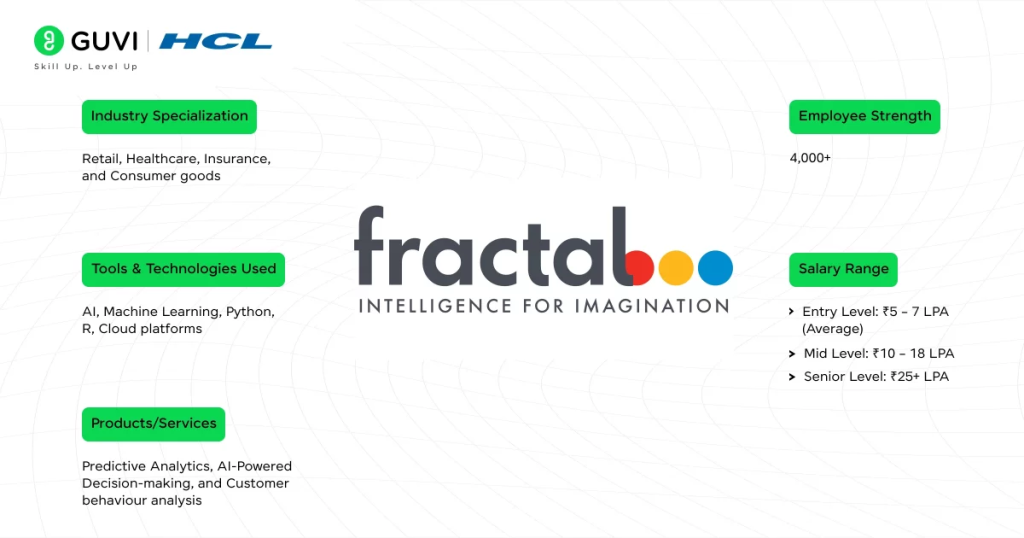
Fractal Analytics specializes in decision intelligence, helping enterprises convert complex data into actionable insights.
Rather than selling generic AI models, Fractal focuses on measurable business outcomes such as improving customer retention, optimizing pricing, or reducing operational costs. This results-driven approach has helped the company secure long-term relationships with global enterprises, creating predictable and recurring revenue streams.
Yellow.ai: Profitable Conversational AI for Enterprises

Source: voicebot
Yellow.ai builds AI-powered chat and voice assistants for banks, telecom companies, and e-commerce platforms.
A key differentiator is its multilingual AI capability, essential for India’s diverse market. The company operates on a SaaS subscription model, allowing enterprises to deploy conversational AI without heavy integration costs. Moving beyond pilots to long-term contracts has been central to Yellow.ai’s revenue stability.
Niramai: AI in Healthcare That Saves Lives and Earns Revenue

Source: inventiva
Niramai applies AI to early-stage breast cancer detection using thermal imaging and machine learning.
Healthcare adoption is slow by nature, but Niramai’s focus on clinical validation and cost-effectiveness has helped it gain trust among hospitals and diagnostic centers. Revenue is generated through B2B licensing, where healthcare providers pay for AI-enabled screening services that improve outcomes while lowering costs.
Haptik: Conversational AI with Clear Business Value

Source: haptik
Haptik provides AI-driven customer support automation to enterprises looking to reduce call center costs and improve response times.
Its pricing model is straightforward; clients pay based on usage and feature depth. Because the benefits are immediate and measurable, enterprises tend to sign long-term contracts, making Haptik’s revenue more predictable than experimentation-driven AI startups.
Arya.ai: AI Powering Financial Risk Decisions

Source: prnewswire
Arya.ai develops AI solutions for banks, insurers, and fintech firms, focusing on credit underwriting, fraud detection, and regulatory compliance.
The financial services sector is willing to pay for AI that reduces losses and improves risk accuracy. Arya.ai monetizes through APIs and enterprise implementations, positioning itself as a specialized fintech AI provider rather than a generic AI platform.
SigTuple: Automating Medical Diagnostics with AI

Source: unboxingstartups
SigTuple uses AI to assist pathologists and radiologists by automating parts of diagnostic workflows.
Revenue comes through hospital and lab partnerships, where AI improves efficiency and accuracy. By embedding AI directly into clinical processes, SigTuple ensures that its technology delivers operational value, not just technical innovation.
Mad Street Den: Retail AI That Drives Sales
Source: vue
Mad Street Den builds visual AI systems that help retailers improve personalization, inventory planning, and product discovery.
Retailers adopt the platform because it directly impacts conversion rates and inventory efficiency. The company follows a SaaS revenue model, proving that AI can drive tangible commercial outcomes in consumer-facing industries.
Locus: Logistics AI with Measurable ROI

Source: locustec
Locus applies AI to route optimization and logistics planning.
What sets Locus apart is its ability to quantify cost savings fuel efficiency, faster delivery times, and reduced operational waste. This makes pricing discussions easier and renewals more likely, resulting in steady subscription revenue.
Uniphore: Voice AI Built for Enterprises

Source: uniphore
Uniphore focuses on voice-based AI automation for large contact centers.
By analyzing conversations in real time, the platform helps enterprises improve compliance, customer satisfaction, and agent performance. Revenue is generated through enterprise licensing, with premium pricing justified by integration into mission-critical operations. While Uniphore reports strong revenue growth, profitability has not been publicly confirmed, which is important to note.
What These Profitable AI Businesses Have in Common
- Industry-specific problem solving
- Strong focus on ROI and measurable outcomes
- Enterprise-grade reliability and compliance
- Scalable SaaS or licensing-based revenue models
- Deep integration into customer workflows
Conclusion
The Indian AI ecosystem is maturing. As this article shows, real money in AI is made by solving real problems, not by showcasing experimental technology.
Companies that align AI capabilities with clear business value, trust, and scalability are the ones generating sustainable revenue. As digital adoption deepens across Indian enterprises, these AI businesses are well-positioned to grow not just in valuation but in actual economic impact.
FAQs
Q1) Is it possible to create an AI business in India and make a profit if only selling to Indian clients?
Yes, some companies are generating significant revenue selling to Indian companies, most importantly in the Fintech, Healthcare, and Logistics Industries.
Q2) What sector is generating the fastest return on investment (ROI) for the AI industry in India?
Fintech and customer experience (CX) have demonstrated the fastest monetization of AI in India due to the clear ROI associated with these solutions.
Q3) Do AI companies have to raise large amounts of capital to make a profit?
No, not necessarily. Many successful AI companies are focused on addressing specific niche enterprise problems and have developed and grown their businesses entirely through the reinvestment of their earned revenue.
Q4) Is AI more profitable as a product or a service?
The monetization of AI occurs primarily within the context of a service or platform via subscription or licensing models.
Q5) Will AI replace traditional software companies in India?
AI will enhance and augment traditional software solutions; therefore, the companies that will lead the future will be those that have combined the two.