India is now stepping into the global space race with private startups. Skyroot Aerospace has quickly become one of the most prominent private space startups. Their Vikram Series is revolutionising how the world looks at launching satellites. Founded in 2018 by former ISRO scientists, Skyroot became the first private Indian company to reach space with the launch of Vikram-S in 2022. To understand how Skyroot is achieving this, let’s look at the company’s background, milestones, and strategy for affordable space access.
Skyroot Aerospace’s Business Profile
Source: Wikipedia
| Founded | 12 June, 2018 |
| Headquarters | Hyderabad, Telangana |
| CEO | Pawan Kumar Chandana |
| Industry | Space |
Establishment of Skyroot Aerospace
Founded in June 2018, Skyroot Aerospace was established by former ISRO scientists Pawan Kumar Chandana and Naga Bharath Daka. They were supported by Vasudevan Gnanagandhi and a small group of entrepreneurs, including Mukesh Bansal and Ankit Nagor, founders of CureFit. They started developing their first rocket in the Vikram series, the ‘Vikram I’, which is expected to launch by the end of 2025.
Partnerships
To build their launch vehicles and scale rapidly, Skyroot formed several strategic partnerships both within India and with private firms. In November 2020, they entered into a Memorandum of Understanding [MoU] with Dhruva Space, an Indian private satellite manufacturer. Following it, in February 2021, they signed a Non-Disclosure agreement [NDA] with ISRO, which gave them access to use the facilities and technical expertise in ISRO centres to develop their launch vehicles.
In the same year, they announced their partnership with Bellatrix Aerospace to use their Orbital Transfer Vehicle with their Vikram series of launch vehicles. The Department of Space has also signed an agreement with them for providing access to ISRO’s facilities and expertise for testing of sub-systems and even systems of launch vehicles. Therefore, they signed this framework MoU on 11 September 2021, with ISRO’s scientific secretary and chairman of the interim IN-SPACe committee, R. Umamaheswaram.
Skyroot’s New Logo and Launch of Vikram-S
Source: India TV News
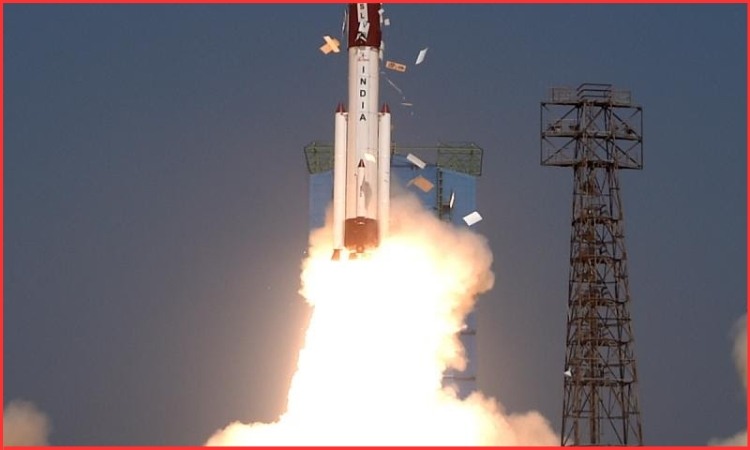
In May 2022, they unveiled a new logo and tagline, ‘Opening Space for all,’ to signal their broader mission. In November 2022, they performed the maiden launch of their ‘Vikram-S’ suborbital rocket, which carried three payloads, including one built by school students. This mission validated key technologies for future Vikram series rockets.
With the success of Vikram-S, Skyroot has attracted government support to expand its facilities. Recently, in January 2025, the Telangana Government signed an agreement with them at the World Economic Forum to establish an integrated private rocket manufacturing, integration, and testing facility in Telangana with an estimated investment of INR 500 crores.
Vikram Series
| Date | Rocket | Launch Site | Orbit |
| 18 November 2022 | Vikram-S | Satish Dhawan | Suborbit |
| 2025 [Planned] | Vikram-1 | Satish Dhawan FLP | Low Earth |
Source: Wikipedia
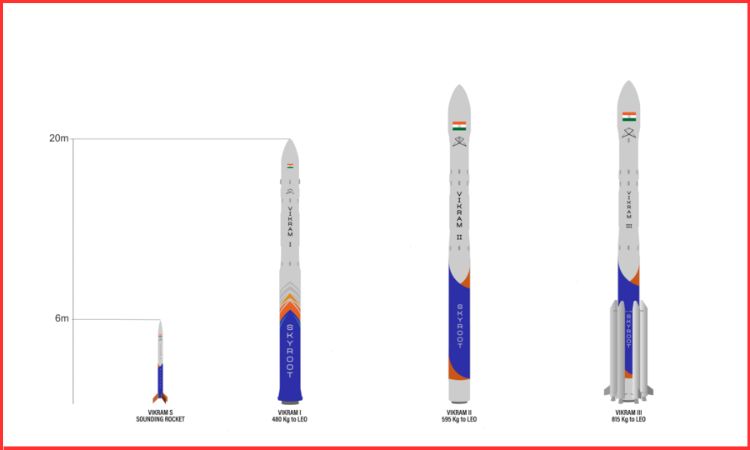
The word Vikram means Brave in Sanskrit. The Vikram series is named after Dr Vikram Sarabhai, founder of the Indian Space Program. The series consists of small-lift launch vehicles developed by Skyroot Aerospace. On November 18, 2022, before a full orbit launch, a suborbital flight of the rocket Vikram S, the sounding rocket was conducted under the name ‘Prarambh’, which means beginning in Sanskrit literature.
Vikram-1
The Vikram-1 is the first rocket in the series that has three solid fuel-powered stages, each with a burn time ranging between 80 and 100 seconds. The final stage is the Raman engine, which is powered by MMH and NTO liquid fuels in a cluster of four engines that generate 3.4 kN thrust. These Raman engines will be used to make final adjustments in the orbit of the stage.
Vikram-1 is designed to lift 290 kg to a 500 km Sun Synchronous Polar Orbit [SSPO] and 480 kg to 45° inclination in a 500 km Low Earth Orbit [LEO]. Its maiden flight is planned for later in 2025.
Development & Testing:
To prepare for their maiden launch, Vikram-1 underwent a series of rigorous tests over several years.
- On 12 August 2020, Skyroot successfully tested the Vikram-1 launch vehicle’s upper stage engine, Raman.
- On 21 September 2020, several Ballistic Evaluation Motors [BEM] were fired to fine-tune and qualify Vikram-1 solid stage propellant formulation.
- On 22 December 2020, they conducted a successful test firing of a solid rocket stage demonstrator ‘Kalam-5’. The test cleared a 24-second-long demonstration, achieving a peak thrust of 5.3 kN.
- On 20 June 2021, Vikram-1’s third stage [Kalam-100] passed the Proof Pressure Test [PPT].
- In May 2022, they won the National Award from the Department of Science and Technology.
- In September 2022, Skyroot got featured in BBC World Report on Indian Space Reforms.
- In March 2023, they won the prestigious Platinum Award as the Best Start-Up at the Telangana State Industry Awards.
- On 10 July 2023, Vikram-1 Stage-2 ‘Kalam 250’ achieved the successful qualification test firing of its igniter.
- On 5 February 2025, they began conducting tests on the carbon composite payload fairing for Vikram-1.
- On 21 May 2025, they successfully qualified the ultra-low-shock pneumatic stage-separation system of Vikram-1.
- On 11 June 2025, they also completed the payload-fairing [PLF] separation test.
Funding Rounds
| Date | Funding Round | Investment | Key Investors |
| June 2018 | Seed Round | $1.5 million | Mukesh Bansal |
| July 2021 | Series-A | $11 million | Greenko Group |
| January 2022 | Convertible Note | $4.5 million | Sherplao Ventures |
| August 2022 | Series-B | $51 million | GIC |
| October 2023 | Pre-Series C | $27.5 million | Temasek |
| Total | – | $95.5 million | – |
Why is the Vikram Series known as Affordable Space Access?
- Skyroot has designed the Vikram series to launch small satellites at the lowest possible cost per kilogram.
- They have used modular, reusable designs and 3D-printed engines to reduce manufacturing expenses.
- They also use a mix of solid propulsion, cryogenic methalox engines, and lightweight carbon composites, which balances performance with affordability.
- They manufacture almost everything in-house in India. This automatically brings down the price of each launch.
- Vikram rockets can be prepared for launch in as little as 24 to 72 hours. This reduces financial risk, lowers operational cost, and provides a rapid turnaround.
- Hence, the Vikram series is affordable because it is built in India with modular and 3D printing and offers quick turnaround.
Market Competition
The market of small satellites has exploded over the past decades. Today, companies, universities, and governments are now deploying nanosatellites and CubeSats for communication, weather monitoring, defence, and research. Globally, Rocket Lab, Astra, Firefly Aerospace, and Relativity Space are providing intense competition. However, Rocket Lab offers launches in the $7-8 million range.
Therefore, Skyroot’s Vikram series focuses on combining low cost with faster turnaround to compete with them. This positions Skyroot Aerospace as a strong player in India for reliable, low-cost satellite launches.
Awards & Recognitions
- On 6 October 2020, Skyroot Aerospace was recognised by the National Startup Awards.
- In March 2021, their team won the Aegis Graham Bell Award for Jury Choice Award under the innovation category.
- On 22 September 2021, Skyroot Aerospace was ranked 7th on India’s ‘2021 LinkedIn Top Startups’ list.
- Skyroot Aerospace became the first private Indian startup to formally enter into an agreement with ISRO for using its assets.
- On 11 May 2022, they were recognised with a National Award at the National Technology Day.
- They also won the Technology Startup Award for Cryogenic, Liquid and Solid Propulsion Technologies, catering to the needs of the small satellite launch vehicle market.
- In November 2022, after the maiden launch of ‘Vikram S’, they became the first Indian private company to reach outer space.
Future Plan
Skyroot is laying the foundation for Vikram-2 and Vikram-3. They are focusing on featuring Vikram-2 with advanced cryogenic methalox engines for higher efficiency and larger payloads. While Vikram-3 will be built with the capability to carry heavier satellites into orbit.
The long-term plan also includes the Dhawan-1 cryogenic engine, which runs on liquid natural gas and liquid oxygen. This green propulsion system is cleaner, safer, and cheaper to produce, aligning with the global push for sustainable space technology.
Conclusion
In 2018, Skyroot Aerospace was just a bold startup idea, but after launching Vikram-S in 2022, it became well-established and recognised. With Vikram-1 preparing for launch in 2025 and plans underway for Vikram-2 and Vikram-3, the company is emerging as a key player in the global small satellite revolution. Thus, by developing cost-efficient designs in India and ensuring rapid turnaround, Skyroot has found ways to make space launches significantly more affordable.
FAQs
Q-1 When will Vikram-1 launch?
The maiden orbital flight of Vikram-1 is planned for late 2025 from the Satish Dhawan Space Centre.
Q-2 Who founded Skyroot Aerospace?
Skyroot Aerospace was founded by ex-ISRO scientists Pawan Kumar Chandana and Naga Bharath Daka.
Q-3 Why is the Vikram Series considered affordable?
The rockets use 3D-printed engines, modular designs, and lightweight carbon composites to reduce the cost of manufacturing.