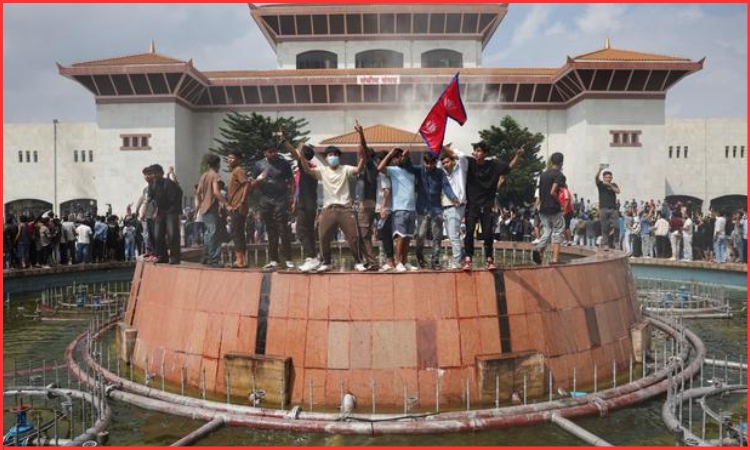
Source: The Hindu
Kathmandu, September 9, 2025—Nepal’s Prime Minister K.P. Sharma Oli resigned on Tuesday after young people were activated throughout the nation in violent protests for two days, ignited by feelings of corruption.
What transpired
The protests began after the government banned people from using popular social media apps such as Facebook, WhatsApp, and YouTube. The ban was lifted later on, but frustration increased as the people called for an end to nepotism, graft, and incompetent administration.
On Monday, authorities deployed rubber bullets and live ammunition to disperse crowds. At least 19 people were killed and about 400 were injured, most of whom were young protesters.
Escalation
On Tuesday morning, crowds continued to gather for protests, despite a curfew in the Kathmandu Valley. Protesters breached the gates of the Parliament complex and set Mr. Oli’s private residence alight in Balkot, Bhaktapur.
Arzu Rana Deuba, the Foreign Minister, was also evacuated from her burning house, as protests spread to other politicians’ houses.
Security Concerns
The violence has raised security concerns outside of Nepal’s borders. In India, Uttarakhand Police ramped up patrols along the Indo-Nepal border, more so near the Kali River.
The Indian government has also asked its citizens to refrain from travel to Nepal until the situation improves. Those who are in Nepal have been advised to stay indoors and follow safety advisories.
Peace talks
Nepal’s security chiefs, like the head of the Army and police, sent out a joint statement urging the protesters to refrain from violence and resolve the crisis through dialogue.
“As the Prime Minister’s resignation has already been accepted by the president, we call upon all to restrain and not to allow more loss to life and property in this difficult situation,” they said.
The statement was signed by Nepal Army Chief Ashok Raj Sigdel, Chief Secretary of the Government of Nepal Ek Narayan Aryal, Home Secretary Gokarna Dawadi, Armed Police Force (APF) Chief Raju Aryal, Inspector General of Police Chandra Kuber Khapung, and National Investigation Department Chief Hutraj Thapa.
Tightened Security Along the Indo-Nepal border with Growing Unrest
Following the outbreak of unrest in Nepal, the Sashastra Seema Bal (SSB) has boosted security near the 1,751-kilometre Indo-Nepal border.
The SSB has increased deployed forces at 22 outposts, while police in five border districts are now using drones to monitor movements. personnel at the Balrampur border where the border stretches for 85 km, are on high alert, intelligence gathering has been intensified, and police and SSB have begun joint patrols.
The ‘charpata’ huts of the ‘Operation Kavach’ committees have also been operationalised to monitor movements across the border vigilantly.
The Road Ahead: Since Mr. Oli’s resignation is perceived as a significant change in Nepal’s politics, the protesters vow to not back down until there have been real reforms. The situation is still quite tense and Nepal can expect more uncertainty over the coming days.