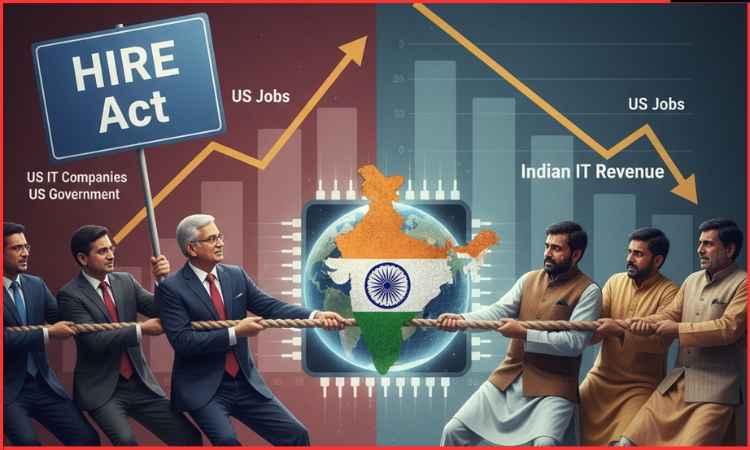
Proposed outsourcing levy could affect $250 billion sector reliant on the U.S. client sector
The proposed Halting International Relocation of Employment (HIRE) Act in the U.S. has caused a tremor in India’s $250 billion IT industry. A bill introduced by Republican Senator Bernie Moreno, the HIRE Act would introduce a 25% tax on payments made to foreign firms by U.S. companies for outsourced work, and remove the availability of treating these payments as tax-deductible business expenses.
If the HIRE Act is passed, it would make outsourcing much more costly for U.S. firms and could affect the revenues of Indian IT giants, including TCS, Infosys, Wipro, HCLTech, and Tech Mahindra and hundreds of Global Capability Centres (GCCs) that operate from India
A Protectionist Push in US Politics
The proposal exemplifies the increase in protectionist sentiment in Washington, D.C. Former Trump advisor, Peter Navarro, and activist, Laura Loomer have both openly supported limits on outsourcing, frequently using the IT industry in India as an example.
Senator Moreno has framed the bill as a bill to bring back American jobs. He stated, “we have thousands of US graduates who are still struggling to find jobs while American corporations still outsource jobs for cheap wages.”
What It Means for India
India relies heavily on the US for more than 50% of its total revenues from IT services. Analysts have warned that the new tax will increase outsourcing expenses by almost 46% when the elimination of deductions is taken into account.
Indian IT companies will have to offload some or all of the costs, and as a result affect margins.
US companies may pass the increase from the new tax on to clients, resulting in higher service costs.
Perhaps the existing workarounds, establishing subsidiary operations in India, will not work since these arrangements may fall under anti-abusive sections of the bill.
What It Means for India
India is dependent on the US for more than 50% of its total revenues from IT services. Analysts have cautioned that the new tax would increase outsourcing costs by nearly 46%, given the lack of deductions.
Indian IT companies will have to pass on some or all of the costs, and thus affect margins.
US companies may pass the increase from the new tax onto clients, resulting in an overall increase in service costs.
Perhaps the workaround that currently exists, by setting up subsidiary operations in India, will not work because those sub-operations may also be caught in anti-abusive provisions in the new taxes.
Next Steps For India
Industry experts believe IT companies in India should treat this as a wake-up call. The industry needs to:
- Develop a greater presence beyond the US in Europe, the Middle East, and Southeast Asia.
- Increase domestic consumption of IT and digital services.
- Invest in innovation and upskilling to move to the higher end of the value chain.
Conclusion
The HIRE Act will not turn India’s IT industry on its head, however, it does highlight a changing political climate in the US. For an industry that to date has relied almost exclusively on American clients, this is a call to action to modify, move with the times and be less dependent on the US and American market before protectionist measures clamp down harder.