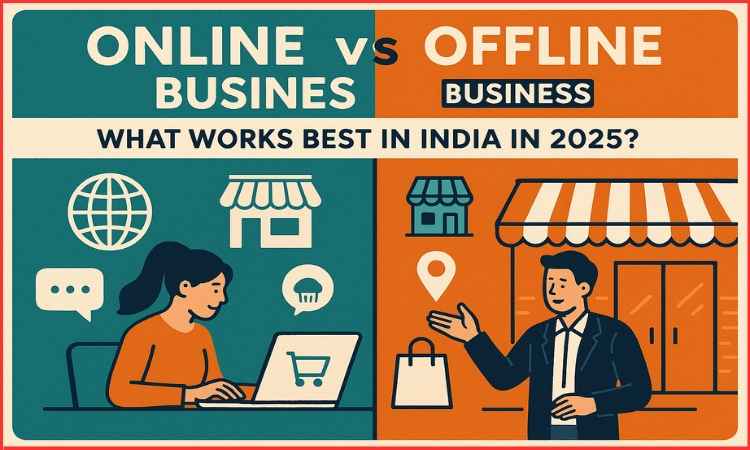
What works best in India’s retail landscape in 2025, Online vs Offline Business, or a combination of both? With technology transforming how customers browse, evaluate, and buy products, the landscape is evolving faster than ever. Online businesses are leveraging digital payments, AI-driven tools, and e-commerce platforms to expand across cities and countries. At the same time, offline retailers continue to hold unique importance with physical experiences, instant gratification, and strong local trust. Hence, this article breaks down the advantages and challenges of both models to understand what works best in India’s retail market in 2025.
Online Businesses in India, 2025
Source: Internet Business Mastery
According to IBEF’s reports, in FY25, India’s e-commerce sector achieved a GMV of approximately Rs. 1.19 lakh crore, reflecting a 12% YoY growth. It is projected to grow to Rs. 3,106,191 crore by 2030. With the increasing use of digital payments, the adoption of e-commerce in smaller cities and union territories is also rising. Government initiatives like the National Logistics Policy, Digital India, and ONDC are boosting the online ecosystem for MSMEs. Thus, in 2025, online businesses are the backbone of India’s retail future, driven by digital payments, smartphone access, and rising regional adoption of e-commerce.
Advantages of Online Businesses in 2025
Source: CedCommerce
Global Reach
Online businesses are selling across cities and even countries at any time with the help of websites and e-commerce platforms. Platforms like Amazon, Shopify, and social media, including Instagram and Facebook, make it easy to access international markets. Thus, online businesses are expanding with potential revenue streams.
Lower Overheads
Online businesses do not require expensive retail space or warehouses to run. Storage needs are fulfilled through automation. Many e-commerce companies offer services of storing sellers’ inventory in their warehouses and shipping products when orders come in. Therefore, there are lower input costs in running an online business.
Flexibility & Scalability
Online businesses can rapidly enter new markets or expand product lines without major physical infrastructure. It is faster and less expensive to scale an online business compared to a physical store. Additionally, flexibility is easily available to keep up with market trends, ensuring rapid growth.
Technology-driven Advantages
With the help of AI and ML, online businesses are personalising product recommendations, predicting trends, optimising pricing, and automating customer support. This streamlines order processing, inventory management, and marketing. The result is improved customer experiences, reduced errors, and increased conversion rates.
Convenience and Accessibility for Customers
Customers can browse products, compare prices, and make purchases from anywhere at any time. They prefer online shopping for speed and flexibility. Hence, online businesses are enhancing customer retention and increasing purchase frequency.
Challenges Faced by Online Businesses in 2025
Source: Gepard PIM
Intense Competition
There are no entry barriers for starting an online business. Due to that, millions of sellers compete in almost every niche market. The impact is shown by increasing Customer Acquisition Costs and reducing profit margins. Thus, e-commerce platforms have multiple sellers listed selling the same product, competing on the pricing of the product.
Logistics and Delivery
Small businesses often lack a robust logistics infrastructure. Their customer ratings and satisfaction suffer from delays or mishandled deliveries because customer expectations have risen due to fast and reliable shipping. Therefore, it is challenging for smaller e-shops to build a dependable logistics system.
Returns and Refunds
Especially in the fashion industry, return rates in online retail are as high as they can be. The cost of reverse logistics reduces the profits of the business. Similarly, several businesses are facing a reduction in profit due to returns and refunds of their products. Hence, returns and refunds for the product make the process of online selling complex.
Cybersecurity RIsks
Online businesses significantly rely on websites, apps, and payment gateways. Thus, the risk of issues like hacking, data breaches, and payment fraud leads to revenue loss. These issues also result in loss of customer trust and sometimes legal consequences. Thus, cybersecurity remains the crucial challenge of online business.
Marketing Costs
Many businesses run paid ads on Google, Instagram, and Facebook to maintain visibility. But these are getting more expensive day by day. Majorly, all online businesses struggle with burning finances due to rising marketing budgets. Hence, Marketing cost also becomes a significant challenge to overcome for online businesses.
Offline Businesses in India, 2025
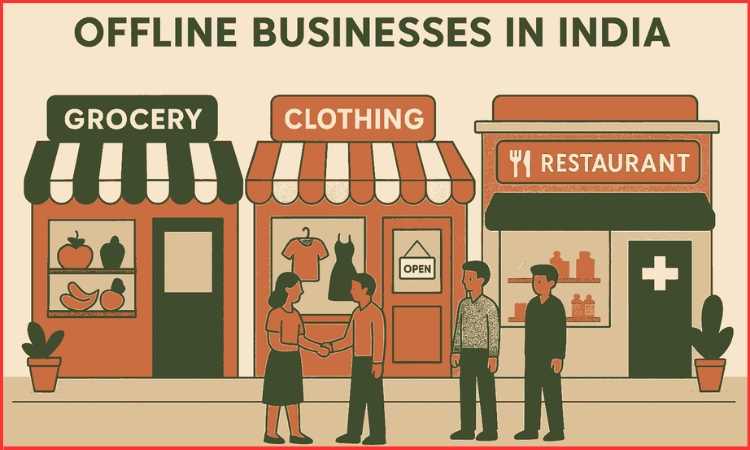
With over 13 million kirana and offline stores driving India’s consumer good sales, the offline sector remains an important segment of everyday commerce in 2025. These micro-retailers have adopted digital payments, embraced the use of mobile apps, and are managing inventory digitally to compete with online commerce. Nearly 45% of Indian shoppers prefer a blend of online and offline channels, especially for fashion and accessories. Thus, in 2025, offline businesses are more about integrating with the digital world while maintaining trust, physical experiences, and adaptability to customer preferences.
Advantages of Offline Businesses in 2025
Physical Customer Engagement
One of the biggest strengths of offline businesses is that customers can physically experience the product before purchasing. The sense of touch, feel, and trial reduces the hesitation of customers and also creates stronger satisfaction at the time of purchase. While online shopping often leads to doubts, mismatches, or dissatisfaction, it can result in the return of the product.
Instant Gratification
Customers do not need to wait for a few days while tracking parcels online. After purchasing a product in an offline business, they can immediately take the product home. Products like groceries, medicines, and emergency purchases are crucial for offline businesses. Thus, instant gratification creates psychological satisfaction for buyers and also encourages impulse purchases that benefit offline retailers.
Local Brand Presence
Having a physical presence increases visibility and credibility in the local community. It also acts as a constant advertisement and builds awareness among customers. It helps businesses to build a loyal customer base in small towns and semi-urban areas. Thus, customers often trust offline businesses more than faceless online sellers.
Less Dependence on Technology
Offline businesses are less affected by website crashes or payment gateway failures. Customers purchase products with cash or cards when digital payment issues or internet outages occur. This ensures the reliability and continuity of the business during unexpected disruptions.
Stronger Human Connection
Offline businesses are built through face-to-face human interactions, not like online businesses on chatbots or service calls. A skilled salesperson offers instant personalised recommendations and solutions that help to build trust with the buyer. Thus, this human interaction strengthens long-term customer loyalty.
Challenges Faced by Offline Businesses in 2025
Limited Reach
Offline businesses are restricted to their geographic area. This results in slow scaling of the business. They have to make large investments to expand across cities. While online businesses are selling across the country and globally without a physical presence. Thus, offline businesses face a significant challenge in expansion and scale.
Changing Customer Preferences
Younger consumers, especially Gen Z, are less inclined to spend hours visiting physical stores unless there is an experience or entertainment aspect attached. With the rising usage of e-commerce platforms, customers are habituated to the convenience of online shopping. Thus, mainly all offline businesses are including more engaging shopping experiences to keep competing with digital convenience.
Inventory Management
Offline stores have to store products physically, which takes a large investment and risk of overstocking and understocking. If demand is miscalculated, like the expiry of perishable goods on the shelves before they are sold, the capital loss keeps on increasing. Thus, in 2025, offline businesses have to face greater inventory-related risks.
Impact of Unforeseen Events
Physical stores are affected by external disruptions, including strikes, bad weather, or political unrest. During the pandemic, all offline businesses were shut down. As of 2025, there is no remote alternative to mitigate the risk of disruptions. Therefore, sales of offline businesses are influenced by external disruption factors.
Higher Operating Costs
Offline businesses have to incur several expenses to run a physical store. Rent, Staff Salaries, Electricity, Insurance, and Maintenance are some of the significant expenses that occur every month. Additionally, inflation also impacts the expenses of running a physical store. Thus, these high fixed costs make it difficult for offline businesses to sustain in the market.
Online vs Offline Business: What works best in 2025 in India?
| Aspect | Online Businesses | Offline Businesses |
| Market Size & Growth | The e-commerce sector achieved Rs. 1.19 lakh crore GMV in FY25 with 12% YoY growth. | Offline retail is driven by 13 million kirana and offline stores, driving FMCG sales. |
| Customer Experience | Convenience of shopping anywhere, anytime and personalised recommendations. | Physical engagement, product trial, instant gratification, and a stronger human connection. |
| Reach | Global reach, no geographical limitations. | Restricted to local and regional markets. |
| Technology Dependence | Heavy reliance on AI, ML, websites, payment gateways, and digital infrastructure. | Less tech-dependent. |
| Operating Costs | Lower overheads due to the absence of physical space and storage. | Higher operating costs driven by rent, salaries, insurance, maintenance, etc. |
| Competition | Highly competitive with low entry barriers. | Competition is limited to local Cmarkets. |
| Risks & Challenges | Cybersecurity risk, returns and refunds, and expensive marketing. | Unexpected events like pandemics, strikes, and scalability. |
| Customer Preferences | Convenience, range of choices, discounts, and speed. | Trusted for authenticity, community connection, and personalised service. |
| Future Outlook | Backbone of India’s retail future. | Evolving with digital adoption. |
Conclusion
In 2025, online businesses lead in reach, scalability, and convenience. While offline businesses excel in trust, human connection, and instant experiences. For businesses, the key lies in blending both approaches strategically. They can leverage digital tools to expand their presence while maintaining the personal touch and reliability of physical stores. Hence, in 2025, a hybrid approach is increasing and emerging as the ultimate solution in India’s dynamic retail landscape.
FAQs
Q-1 Can offline businesses survive in the age of e-commerce?
Yes, offline stores can survive in the age of e-commerce by integrating digital payments, catering to customers’ preferences, and maintaining human interaction.
Q-2 Which type of business is growing faster in India, online or offline?
Online businesses are growing rapidly with the rising use of e-commerce platforms.
Q-3 What are the biggest challenges for online businesses in 2025?
Intense competition, logistics issues, high marketing costs, and complications with returns and refunds are some of the biggest challenges for online businesses in 2025.