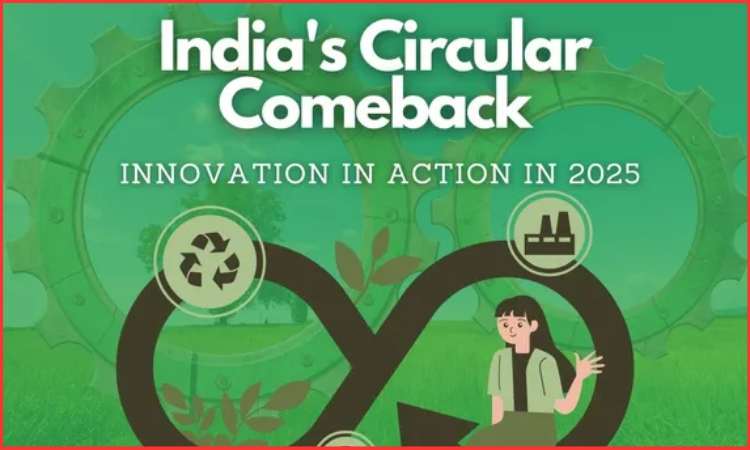
By 2025, India will be at an inflection point as the circular economy transforms industries across the nation. The circular economy ecosystem emphasizes re-use, recycling, and regeneration rather than the traditional “take-make-dispose” model. Circular economy for Indian industries means more than just awareness; it is about optimizing operations, enhancing competitiveness, and aligning with sustainable practices.
Source: TICE News
The transition to a Circular Economy by 2025 is being driven by government policy, corporate strategy, and consumer involvement. The various industries’ readiness to commit investment into implementing circular economy policies, from waste management to sustainable supply chains, demonstrates a shift taking place across manufacturing, textiles, construction, and retail sectors in India.
NITI Aayog and KPMG have also reported that circular economy models could create trillions of dollars in value while reducing India’s carbon footprint. This blog dives into how the circular economy is transforming the Indian industry by 2025.
What Is the Circular Economy?
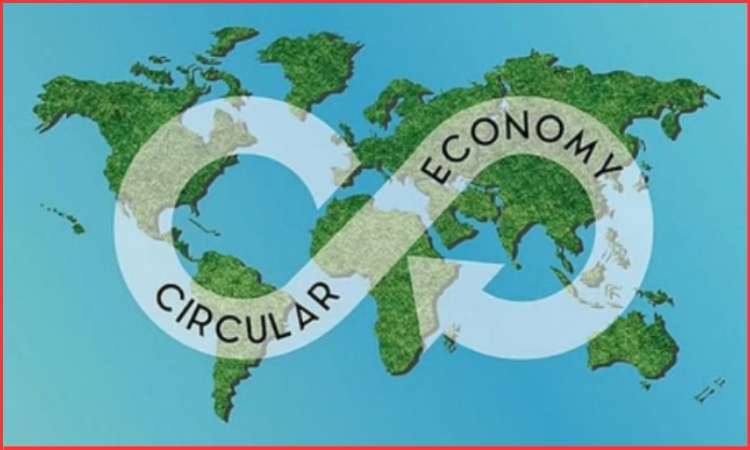
The circular economy is a new take on the traditional linear model of “take, make, dispose.” Instead of depleting resources and creating waste, it embraces closed loops. Products are designed to last longer, materials are recycled, and waste is treated as a resource.
Source: IBEF
In 2025, the model is making a strong impact across industries. It pushes businesses to consume less raw materials, optimize energy, and rethink supply chains. For Indian industries, the circular economy is about reducing reliance on imports, reducing costs, and using international sustainability benchmarks.
The circular economy is not only an environmental solution, but it is also an economic opportunity. By reusing and recycling, industries can create new business opportunities, promote innovation, and mitigate the pressure on India’s scarce natural resources.
The Importance of the Circular Economy for India
Indian industries are facing increasing pressure due to climate change, resource shortages, and rising energy demands. With a population of over 1.4 billion people, India must balance its industrial growth ambitions with sustainability. The circular economy offers a realistic pathway to do both.
A recent NITI Aayog report found that adopting circular practices could save billions of dollars annually by improving resource efficiency. For Indian industries, a reduced production cost and better ability to withstand global supply chain shocks translate to economic competitiveness.
In 2025, consumers are more sustainability-conscious, and industries adopting circular practices improve trust, build stronger reputations, and stay competitive in domestic and global markets. The circular economy is not only important for decarbonising and creating green jobs, but it ultimately becomes the foundation for India’s sustainable growth narrative.
Key Industries Driving Change in India (2025)
The circular economy is slowly changing industries in India, with some sectors leading the way by reformulating processes, eliminating waste, and developing new value streams. Here are the leading sectors of change in 2025:
1. Manufacturing
Indian manufacturers are welcoming green manufacturing and recycling. Manufacturers are now developing products with longer lifecycles and reusing industrial waste materials. The auto sector is refurbishing old components and recycling metals to reduce dependence on imports. In 2025, Tata Motors expanded its vehicle scrappage and recycling program, recovering metals and reusing components in line with the government’s Vehicle Scrappage Policy. This shows how automakers are closing the loop and reducing raw material dependence.
2. Textiles and Fashion
India’s textile industry is one of the largest polluters; however, it is transitioning towards circular business models. Textile brands are recycling fabrics, using organic fibers instead of raw materials, and expanding resale markets. Circular fashion reduces water consumption and reduces the enormous challenge of disposing of textile waste. Textile leaders like Raymond and Aditya Birla Fashion have launched resale and recycling initiatives in 2025, cutting textile waste and moving closer to circular fashion.
3. Construction and Infrastructure
The construction industry is using fly ash bricks and building debris as recycled materials. Green building measures are changing how Indian cities grow in 2025. Recycling of raw material promotes significant emissions reduction and can save money in mega projects.
4. Retail and Consumer Goods
Retailers are emphasizing the reuse of packaging and cutting down on waste. Consumer goods companies are researching “product as a service” models – in this manner, consumers interact with products for a period of use rather than by ownership. These actions are changing the manner in which industries do business within the increasingly environmentally conscious Indian consumer space. Flipkart and Amazon India are scaling reusable delivery packaging pilots, which directly reduce single-use plastics and align with growing consumer demand for sustainability
5. Waste Management and Recycling
Waste management is at the core of India’s circular economy. Industries are pairing with recycling companies/start-ups to conduct an operation where waste becomes a raw material. Recycling plastics and processing electronic waste creates business developments and jobs for a growing responsibility.
Government Policies and Initiatives Promoting the Circular Economy in Indian Industries (2025)
Remember, the circular economy in India is not only being executed by industry, but it is also buoyed by the government. In 2025, various policies and programs are enabling Indian industries to shift to sustainable models.
1. Extended Producer Responsibility (EPR)
This law makes companies responsible for collecting and recycling or safely disposing of their products after use. EPR rules for plastics and e-waste laws require industries to redesign their packaging to reduce waste.
2. Waste-to-Wealth Mission
This mission was started under NITI Aayog as part of the emerging technologies mission of NITI Aayog, and promotes and connects technology that takes waste streams and converts them into something useful. It is important as one of the ways to help motivate Indian industries to invest in recycling, composting, and resource recovery systems.
3. National Resource Efficiency Policy (NREP)
The aim is to reduce consumption of resources and promote circular economy practices domestically from the elements of construction, manufacturing, and transport. The national policy will assist industries with a framework to recycle materials and reduce emissions.
4. Green Credit Program
The industries obtain credits for using sustainable and circular practices. These credits are transferable, which gives industries a financial incentive to be environmentally friendly.
5. Swachh Bharat Mission 2.0
This mission is about waste segregation, recycling, and scientific disposal of municipal waste. It offers industries the chance to partner in large-scale recycling and composting programs.
6. India’s Net Zero Commitment
India wants to achieve net zero by 2070. Circular economy practices will help to reduce emissions generated by industries, which will help India deliver on its net-zero commitment.
Challenges and Opportunities for Indian Industries in Opting for the Circular Economy (2025)
High Start-up Costs
For the most part, the greatest impediment faced by many Indian industries in adopting circular economy practices is the high start-up costs. New recycling systems, redesigned supply chains, and cleaner technology all require considerable amounts of capital. Despite long-term benefits, SMEs, India’s economic backbone, often cannot bear these high costs.
Lack of Awareness and Human Capital
The circular economy is widely discussed, but many Indian industries still lack awareness, skilled manpower, and proper implementation. There are clear gaps in workforce skilling, common technical training, and skills awareness campaigns, so as to accelerate the eco-transformation plan across sectors. If not addressed in the present, the risk for industries may fall further behind global sustainability standards.
Fractured Waste Management Systems
Waste management systems in India are still highly fractured. For some industries and cities, advanced recycling practices are rapidly being adopted. However, for the large majority of other industries or cities, the inefficiencies in collection, segregation, and processing are still slow. This inconsistency slows large-scale eco-transformation and limits the full potential of the circular economy in 2025.
Policy Support and Enforcement
While the policies that support circular practices in India are strong, they are not necessarily well policed, since many industries are only partially compliant, and many monitoring systems are weak. Stronger enforcement and transparent reporting systems are needed to ensure compliance with circular economy regulations.
Innovation and Market Development
On the positive side, circular economy models provide enormous opportunities for Indian industries. Innovations in green technologies, sustainable packaging solutions, and renewable energy have generated new markets. Start-ups and large-scale corporations alike are constructing new business models that reduce waste and create jobs and profits.
Global Competitiveness
By adopting circular economy models for their products and services, Indian industries will be better able to meet sustainability-related expectations from international markets. This will enhance India’s export capacity and improve foreign investment attractiveness. As industries embrace circularity by 2025, they will be situated in the best possible position to compete in international markets where sustainable product options are becoming increasingly important to buyers.
The Road Ahead: How the Circular Economy Will Shape Indian Industries beyond 2025
The circular economy will continue transforming Indian industries beyond 2025, as technology advances and sustainability becomes a core business commitment. Industry leaders will transition from pilot projects and small-scale implementation to widespread integration. Government, industries, and startups will work together in deeper collaboration, and with strong policies, the best waste infrastructure, and circular actions, India will evolve into a resource-efficient economy.
Technology is factoring into supply chain transparency via digital tools like artificial intelligence and blockchain, while efficiency, sustainability, and carbon reduction are being propelled by renewable energy, revolutionary green materials, and industrial competitiveness. The circular economy for Indian industries will be more than an option along a supply chain; it will be the bedrock for global positioning as they grow and become more resilient in a resource-constrained world.
Conclusion
The circular economy isn’t just a trend toward sustainability; it’s a catalyst that is actively reshaping Indian industries in 2025. By thinking differently about resource use, businesses are lowering costs, minimizing environmental impact, and producing new possibilities. With strong government support, a cohort of innovative startups, and willingness from consumers, India has the potential to be a leader in circular economy practices at scale.
For industries, this means that adopting circular models isn’t just about cost compliance; it’s about being ahead of the curve. As the Indian economy matures, the principles of the circular economy will always be instrumental in establishing industrial resilience, resource security, and sustainability in development.
Indian industries that seek to innovate circularly today will be the ones to generate growth, profits, and positive impact tomorrow.
FAQs
1. How can small, medium-sized enterprises adopt circular economy practices?
They can embrace circular economy practices by starting with the small things, like energy savings, waste savings, as well as developing partnerships with local recyclers.
2. What is the role of technology?
Technology such as AI (artificial intelligence), IoT (internet of things), and blockchain endeavors to track resources, decrease waste, and improve operational efficiency in a circular economy.
3. What are the new jobs created through the circular economy?
Many roles are being created, such as green construction, eco-innovation, recycling, and waste management.
4. Are consumers in India ready for circular products?
Yes, consumers in India are increasingly demonstrating a greater level of awareness as a whole, and there is a growing number of consumers who prefer green, sustainable products.
5. How does this activity contribute to India’s net-zero goal?
This will contribute to emission reduction, partly through reusing resources and reducing waste throughout the industry.