As retail transforms, convenience has become a key driver for consumer purchasing habits. Quick commerce startups lead this transformation in terms of last-mile logistics, delivering goods in ten minutes or less. Whether it’s groceries or medical supplies, in response to the consumer’s desire for an immediate “now” service.
Source: LinkedIn
In India, this has been pioneered by Zepto and Blinkit, while huge international players like Gorillas, Flink, Getir, and GoPuff are changing markets around the world. As fast delivery gets faster, these changes have occurred as a result of technology, hyperlocal warehouses, and supply chain capabilities. Quick commerce is a trend that is shaping the future of retail globally as the industry develops; it is not merely a fad or a technology that is altering retail. Quick commerce startups are the future of 10-minute delivery.
The Evolution of E-commerce and the Rise of 10-Minute Delivery
Over the years, e-commerce has changed significantly. Initially, e-commerce was based on convenience and variety, with delays of days and sometimes weeks in delivery time. As technology developed, logistics improved, and delivery timeframes were reduced, even domestically in North America to two to three days. Mobile applications and tracking in real-time further enhanced the shopping experience for consumers and made online retail a less prohibitive interaction.
The next jump in e-commerce was with the introduction of startups within quick commerce that have optimized delivery windows into roughly 10-minute delivery times. Key to achieving this timeline was the introduction of hyperlocal fulfillment centers, real-time stock levels of delivery center inventories, and the use of Artificial Intelligence to maximize routes from fulfillment to the customer’s doorstep. In Mumbai and other dense urban areas of India, companies like Zepto and Blinkit are well poised to reach their customers almost instantaneously. Globally, other players like Gorillas, Flink, Getir, and GoPuff stand to replicate these models of quick commerce in cities marked by increased density.
The trend of 10-minute delivery reflects the increasing consumer expectation for immediacy. Speed is no longer only a perk for shoppers; it is a required competitive differentiator. Quick commerce represents a transforming piece of the retail puzzle and will always be a crucial part of the last-mile logistics revolution for all retail consumers worldwide.
Key Players in the Quick Commerce Market
Quick commerce is enabled by tech startups and e-commerce companies that have adapted to changing consumers’ demands for higher speed. In India, the key players in this space are Zepto and Blinkit, who have developed an advanced tech-enabled inventory management and delivery network that helps them deliver goods in 10 minutes using a network of ultra-fast grocery stores within densely populated urban centers. Swiggy Instamart is consolidating quick commerce with its food delivery business model to solidify its position in the grocery delivery space.
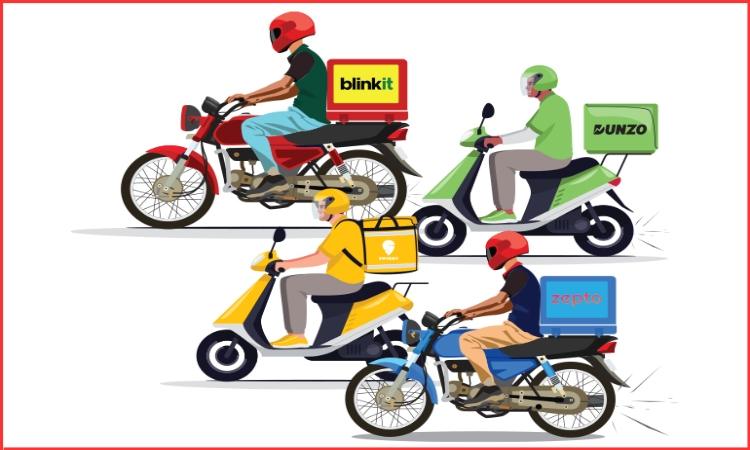
Source: The Hawk
Across the globe, a mix of technology-enabled startups, such as Companies including Getir, Gorillas, Flink, and GoPuff, are helping reform convenient retail. These startups have continued to rely upon using micro-fulfillment centers, advances in predictive analytics, and forming a new model for managing last-mile delivery operations. These companies are working to attract customers by focusing on delivering speed, reliability, and creating value to satisfy paying customers.
Investors are diversifying their portfolios to include these start-ups that will disrupt the convenience retail sector in urban India and across major cities in the world. Leading organisations in the rapid commerce area are investing in every facet of their operations to keep ahead of the competition. This includes improving and optimising the technology they use, strengthening their alliances, and revising their procedures. This is a blatant indication of future growth prospects in international retail.
Benefits of Quick Commerce for Consumers and Businesses
Quick commerce, which offers a combination of speed, convenience, and efficiency, is advantageous for both consumers and businesses. For consumers, delivery in 10 minutes for products like groceries, medication, personal care products, and so on is essentially delivered instantly, so the immediacy offered makes it a good fit for the busy urban lifestyle that people live, where time is essentially at a premium. In addition, the appeal of being able to buy spontaneously is possible with quick commerce, as it fills the gap between being in a local store and being on an e-commerce site.
For businesses, quick commerce promotes customer loyalty and increases brand loyalty and customer perception of the brand. Quick commerce can ensure a faster turnover of inventory increases which leads to decreased holding costs. Businesses benefit from quick commerce with knowledge from frequent transactions that foster information for determining demand. Many startups in India and abroad will use this information to guide refinement in their operation and scale.
Additionally, quick commerce affords a competitive edge in retail environments with many other businesses competing for customers. Startups that reliably and quickly deliver suggestions to build customer purchase capacity and often tend to return, while driving up the market share on a per metro basis (local). As urban populations grow and the expectations placed by consumers rise, the efficiency and urgency of quick commerce will make businesses operate more quickly around the globe.
Challenges in the Quick Commerce Industry
- Logistics Complexity – 10-minute delivery requires a complex micro-distribution network as well as an effective process for real-time inventory monitoring and routing. Any deviation could create delivery delays, with a detrimental effect on customer confidence.
- High Operational Costs – Quick commerce start-ups incur costs for warehousing, delivery agents, technology, and fuel. In every country, including India, achieving the balance of speed and profitability is critical.
- Sustainability Pressures – Small deliveries over a short period result in a negative effect in terms of carbon footprint and packaging. The environmental responsibilities feel like additional issues for start-ups with a sustainability ethos.
- Scalability Issues – Achieving 10-minute delivery in locations outside of the analytical hubs of dense urban areas is effectively impossible. Start-ups need to adapt a model to less dense areas and continue to deliver as quickly as possible while maintaining service levels.
- Inventory Management – Hyper-local delivery models require accurate forecasting of demand for the delivery area. If firms overestimate or underestimate demand, it will have a severe effect on the customer’s 10-minute delivery service, thereby damaging the value of the service.
- Regulatory & Labor Environment – In different parts of the world, in India specifically, labor regulations and city-specific regulations will impact the effective logistics of the firm to service the demand in multiple urban environments.
Best Practices for Quick Commerce Startups
- Utilize Technology – Take advantage of technology such as AI-assisted inventory management, predictive analytics, and route optimization to deliver consistent and timely ten-minute delivery and remove inefficiencies in your operation.
- Establish Partnerships – Partner with local suppliers, delivery partners, and tech partners to increase your reach, improve your delivery reliability, and become a low-cost provider in both India and global markets.
- Micro-Fulfillment Optimization – Place small distribution centers closer to where the demand is high. This means a shorter delivery time, better inventory freshness, and allows you to be more agile in your capacity to grow.
- Customer Experience – Above everything, think of the customer. Get the delivery right, make the return process easy, and provide great post-purchase customer service. Consumers will return if they are happy, and consumers who are happy become your best advocates.
- Sustainability – Consider using eco-friendly materials for packaging, when able, make every delivery count by consolidating orders, and transition to electric or hybrid vehicles to reduce any speed vs. sustainable impact.
- Analyse Data – Track the speed of your deliveries, understand customer preferences; use data to identify demand shifts for better operational refinement, efficiency, and scalability.
The Road Ahead for Quick Commerce
The future of quick commerce is bright, in India and globally. Consumers globally want instant gratification, driving a new startup every 10 minutes to compete with one another in the quest to provide consumers with what they want, under the term “quick commerce.” If technology continues to advance, 10-minute delivery may well become the norm, and in urban areas as city centers grow, consumers will not just be able to get their groceries, medicines, and essentials, but their whole shopping experience will be competently and efficiently transformed.
In India, entrepreneurs will be extremely motivated to scale new business models because of the huge population, and with this prime momentum, there will be movements of expansion in global realms. Countries where millions of consumers may not have previously seen a quick commerce, like India, Malaysia, Nigeria, Brazil, and even Iran. If you look at firms like Getir, Gorillas, GoPuff, and regional startup movements, they are all chasing the quick commerce expansion in numerous new cities and geographies.
Meaningful advancements must also be made on sustainability. While consumers may not be familiar with slower methods like bike messengers, you can’t forget about the weight of this business from a global climate perspective. Today, millions of deliveries are being made globally, where the goal of quick commerce is to deliver each one faster than ever, and when you think about that, efficient routes, optimized methods, electric vehicles, sustainable methods, and even delivery packaging can reduce a carbon footprint anywhere. When you take delivery speed to 10-minute delivery, you also need to consider your 10-minute responsibility.
Partnerships and technology are what will define the market leaders. Larger companies and partnerships with local retailers, data-driven demand forecasting, improved units of capacity with fulfillment centers, warehouses, apps, and fulfillment would be a plus to accelerate scaling. The firms that balance speed, reliability, and sustainability will be the winners in a fast-paced, evolving global marketplace.
FAQs
1. What types of products work with 10-minute delivery?
Perishable goods such as groceries, fresh fruits and vegetables, medicine, and everyday goods work well because of their urgency and frequent purchase.
2. How do quick commerce start-ups deal with demand during peak hours?
They use dynamic workforces, real-time inventory management, and predictive analytics to adapt to demand surges, while avoiding delays in delivery.
3. Can a 10-minute delivery service be profitable for startups?
Yes, with effective operational design, hyperlocal fulfillment processes, and efficient labor enabled by technology or optimization practices, they can create a balance between speed and profitability over time.
4. Does quick commerce work in rural areas?
For now, they are mostly concentrated on dense metropolitan areas since rural areas have lower demand density and longer distances for delivery, which complicates 10-minute delivery.
5. How do startups offer product quality during ultra-fast delivery?
They ensure temperature control, proper packaging, and appropriate personnel in order to keep products in quality condition from their warehouse to the front step.